
Absolutely — But Before You Start Unbolting Everything, Find Out Whether That Fifth-Wheel Setup Should Stay With the Truck.
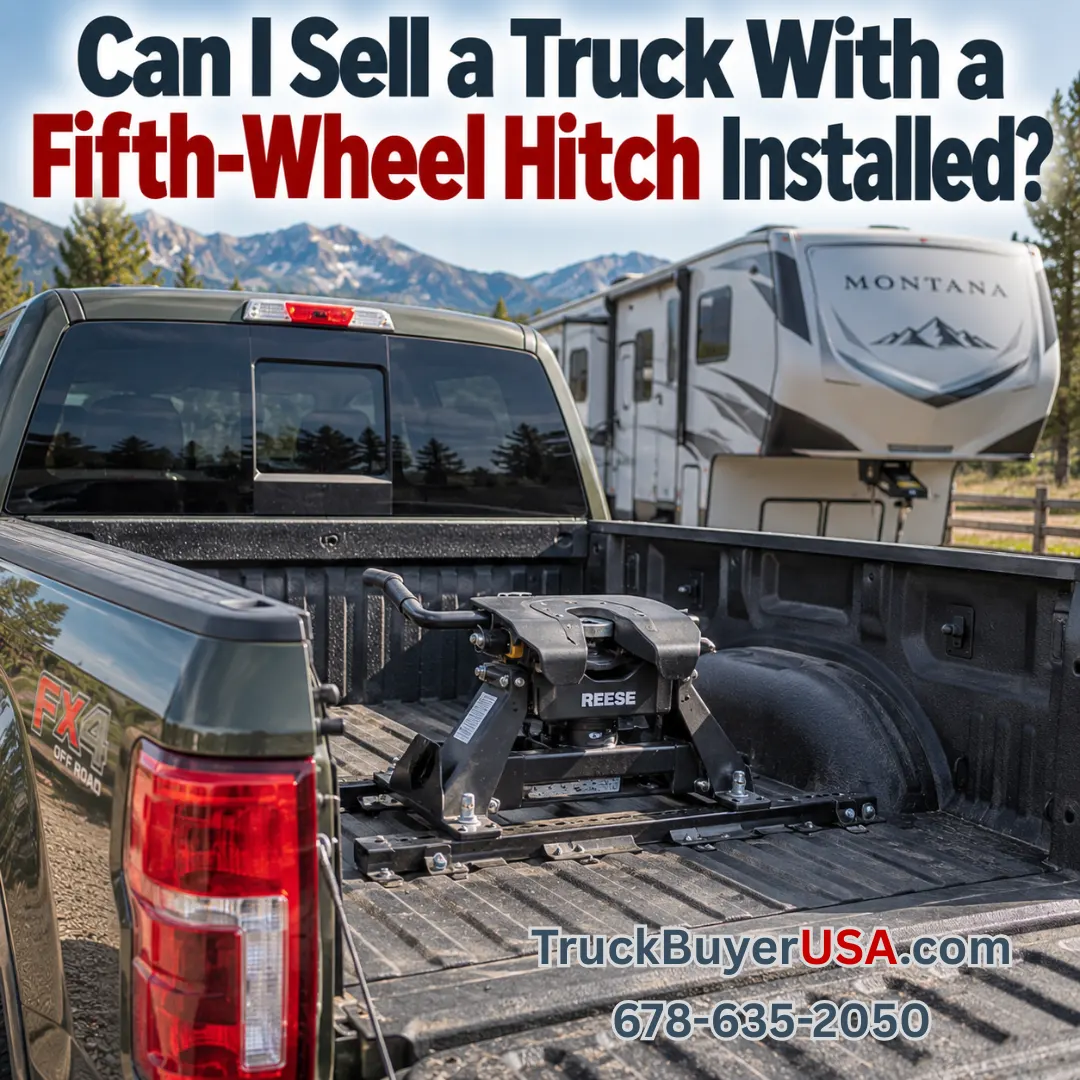
If you've used your pickup to pull a fifth-wheel camper, horse trailer or heavy equipment trailer, there's a good chance the bed doesn't look like it did when the truck left the factory. You may have rails, mounting points, brackets or an entire fifth-wheel hitch sitting back there.
Now you're ready to sell the truck, and the obvious question is: Do I have to remove all of that first? Usually, no. You can sell a truck with a fifth-wheel hitch installed. In some cases, leaving the towing equipment in place may actually make the truck more appealing to the right buyer. In others, the hitch itself may add little to the truck's resale value.
The important thing is not to start spending money removing equipment until you understand what you're selling.
A Fifth-Wheel Hitch Tells Buyers Something About the Truck
A properly installed fifth-wheel setup can be useful equipment. Someone shopping specifically for a tow vehicle may appreciate finding a truck that's already equipped for the job.
But the hitch also tells a buyer something else: this truck has probably towed. That isn't automatically bad. Heavy-duty pickups are built to work, and towing is exactly why many people buy them. However, buyers evaluating a used tow vehicle may pay closer attention to mileage, transmission performance, cooling systems, suspension, brakes, tires, rear axle components and maintenance history.
A fifth-wheel hitch doesn't automatically hurt your truck's value. The condition of the truck carrying it matters much more.
WHAT SHOULD YOU DO WITH YOUR FIFTH-WHEEL SETUP?
Situation |
What Sellers Should Consider |
|---|---|
Complete hitch still installed |
Truck can generally be sold with it in place |
Only bed rails/mounts remain |
Don't assume removal is necessary before selling |
Factory/OEM prep package |
Usually best left intact as part of the truck's configuration |
Aftermarket under-bed system |
Identify the manufacturer/system when possible |
Bed has drilled mounting holes |
Removing the hitch won't erase the modifications |
Rust/damage around mounting points |
Disclose it; condition can matter more than the hitch |
You want the hitch for your next truck |
Determine whether it's compatible before removing it |
Don't Spend $500 Solving a $0 Problem
This is where sellers can waste money. You decide the truck needs to look "stock" before you sell it, so you pay a shop to remove the hitch, rails and brackets. Then you discover there are still holes in the bed, mounting hardware underneath or evidence that towing equipment was previously installed.
You've spent money without necessarily making the truck more valuable. Worse, removing a professionally installed towing system simply to make the bed look cleaner could eliminate equipment that another truck buyer would have wanted.
If you're planning to reuse the hitch in another pickup, that's different. But check compatibility first. Bed dimensions, mounting systems, puck configurations and hitch requirements vary. Don't pay to remove equipment based on the assumption that it'll bolt directly into your next truck.
Be Honest About How the Truck Was Used
If your truck spent years pulling a 14,000-pound fifth wheel across the country, don't describe it as Grandma's grocery getter.
That doesn't mean the truck is ruined. It means its actual condition and maintenance history matter. A well-maintained diesel pickup that regularly towed within its capabilities can be a far better truck than one that never pulled a trailer but was neglected for 150,000 miles. Service records can be particularly useful when selling a truck that's clearly been used for towing.
Also know what equipment you're selling. If possible, identify the hitch manufacturer, weight rating and whether the truck has factory towing preparation or aftermarket components. Never assume the presence of a hitch means the truck is rated to tow a particular trailer; actual towing and payload capacities depend on the truck's specific configuration.
Before You Remove That Hitch, Get Your Truck's Value
This is the part that could save you unnecessary work and money. Don't automatically remove the fifth- wheel hitch. Don't automatically repair every hole in the bed. And don't spend hundreds of dollars trying to erase evidence that your pickup was used as a pickup.
Go to TruckBuyerUSA.com and find out what your truck may be worth in its current condition. TruckBuyerUSA buys trucks nationwide, including pickups that have worked, hauled and towed. Whether you've got a diesel dually with a fifth-wheel setup, a heavy-duty work truck or an older pickup that's finished hauling the family RV, start by getting the truck evaluated before spending money preparing it for sale.
Your fifth-wheel hitch doesn't automatically make your truck harder to sell.
The bigger mistake may be paying to remove perfectly usable equipment before you even know whether you need to.
Ready to Stop Towing? Maybe It's Time to Stop Owning the Tow Truck, Too.
Visit TruckBuyerUSA.com, tell us what you've got and get your truck's value. Hitch, rails, towing history and all, let our team evaluate the truck you actually own before you spend another dollar on it.