Sell Your Truck
Fast, Safe & Easy

No Hassles. We Come To You.
888-724-2058

Can I Sell a Truck With a Fifth-Wheel Hitch Installed?

- Tuesday, September 15, 2026

Absolutely — But Before You Start Unbolting Everything, Find Out Whether That Fifth-Wheel Setup Should Stay With the Truck.
TruckBuyerUSA - Can I Sell a Truck With a Fifth-Wheel Hitch Installed?


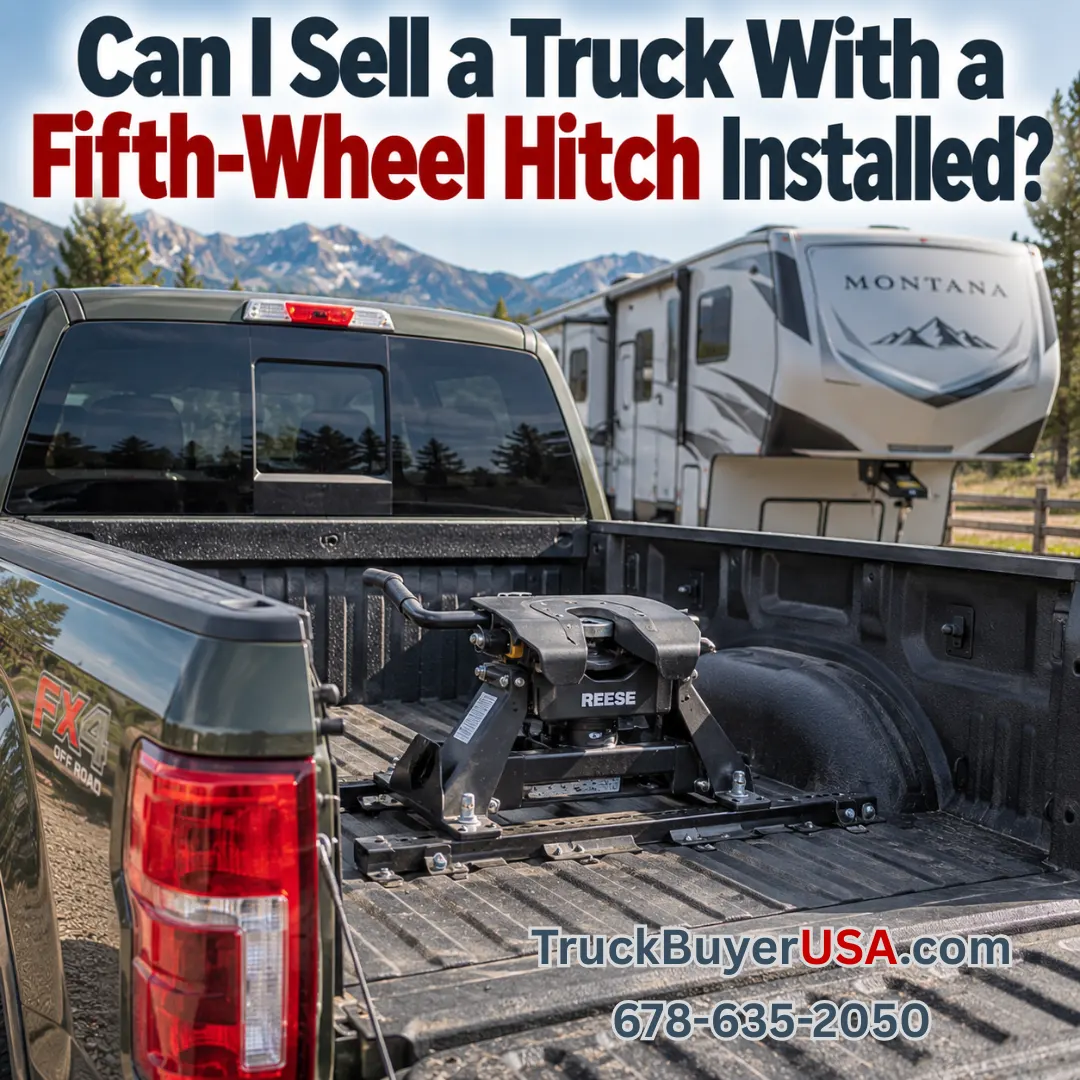
If you've used your pickup to pull a fifth-wheel camper, horse trailer or heavy equipment trailer, there's a good chance the bed doesn't look like it did when the truck left the factory. You may have rails, mounting points, brackets or an entire fifth-wheel hitch sitting back there.

Now you're ready to sell the truck, and the obvious question is: Do I have to remove all of that first? Usually, no. You can sell a truck with a fifth-wheel hitch installed. In some cases, leaving the towing equipment in place may actually make the truck more appealing to the right buyer. In others, the hitch itself may add little to the truck's resale value.

The important thing is not to start spending money removing equipment until you understand what you're selling.

A Fifth-Wheel Hitch Tells Buyers Something About the Truck

A properly installed fifth-wheel setup can be useful equipment. Someone shopping specifically for a tow vehicle may appreciate finding a truck that's already equipped for the job.

But the hitch also tells a buyer something else: this truck has probably towed. That isn't automatically bad. Heavy-duty pickups are built to work, and towing is exactly why many people buy them. However, buyers evaluating a used tow vehicle may pay closer attention to mileage, transmission performance, cooling systems, suspension, brakes, tires, rear axle components and maintenance history.

A fifth-wheel hitch doesn't automatically hurt your truck's value. The condition of the truck carrying it matters much more.

WHAT SHOULD YOU DO WITH YOUR FIFTH-WHEEL SETUP?

Situation
What Sellers Should Consider
Complete hitch still installed
Truck can generally be sold with it in place
Only bed rails/mounts remain
Don't assume removal is necessary before selling
Factory/OEM prep package
Usually best left intact as part of the truck's configuration
Aftermarket under-bed system
Identify the manufacturer/system when possible
Bed has drilled mounting holes
Removing the hitch won't erase the modifications
Rust/damage around mounting points
Disclose it; condition can matter more than the hitch
You want the hitch for your next truck
Determine whether it's compatible before removing it

Don't Spend $500 Solving a $0 Problem

This is where sellers can waste money. You decide the truck needs to look "stock" before you sell it, so you pay a shop to remove the hitch, rails and brackets. Then you discover there are still holes in the bed, mounting hardware underneath or evidence that towing equipment was previously installed.

You've spent money without necessarily making the truck more valuable. Worse, removing a professionally installed towing system simply to make the bed look cleaner could eliminate equipment that another truck buyer would have wanted.

If you're planning to reuse the hitch in another pickup, that's different. But check compatibility first. Bed dimensions, mounting systems, puck configurations and hitch requirements vary. Don't pay to remove equipment based on the assumption that it'll bolt directly into your next truck.

Be Honest About How the Truck Was Used

If your truck spent years pulling a 14,000-pound fifth wheel across the country, don't describe it as Grandma's grocery getter.

That doesn't mean the truck is ruined. It means its actual condition and maintenance history matter. A well-maintained diesel pickup that regularly towed within its capabilities can be a far better truck than one that never pulled a trailer but was neglected for 150,000 miles. Service records can be particularly useful when selling a truck that's clearly been used for towing.

Also know what equipment you're selling. If possible, identify the hitch manufacturer, weight rating and whether the truck has factory towing preparation or aftermarket components. Never assume the presence of a hitch means the truck is rated to tow a particular trailer; actual towing and payload capacities depend on the truck's specific configuration.

Before You Remove That Hitch, Get Your Truck's Value

This is the part that could save you unnecessary work and money. Don't automatically remove the fifth- wheel hitch. Don't automatically repair every hole in the bed. And don't spend hundreds of dollars trying to erase evidence that your pickup was used as a pickup.

Go to TruckBuyerUSA.com and find out what your truck may be worth in its current condition. TruckBuyerUSA buys trucks nationwide, including pickups that have worked, hauled and towed. Whether you've got a diesel dually with a fifth-wheel setup, a heavy-duty work truck or an older pickup that's finished hauling the family RV, start by getting the truck evaluated before spending money preparing it for sale.

Your fifth-wheel hitch doesn't automatically make your truck harder to sell.

The bigger mistake may be paying to remove perfectly usable equipment before you even know whether you need to.

Ready to Stop Towing? Maybe It's Time to Stop Owning the Tow Truck, Too.

Visit TruckBuyerUSA.com, tell us what you've got and get your truck's value. Hitch, rails, towing history and all, let our team evaluate the truck you actually own before you spend another dollar on it.
Does Rust Under My Truck Lower Its Resale Value?

- Monday, September 14, 2026

Yes! And the Difference Between Surface Rust and a Rusted-Out Frame Can Mean Thousands of Dollars.

TruckBuyerUSA - Does Rust Under My Truck Lower Its Resale Value?


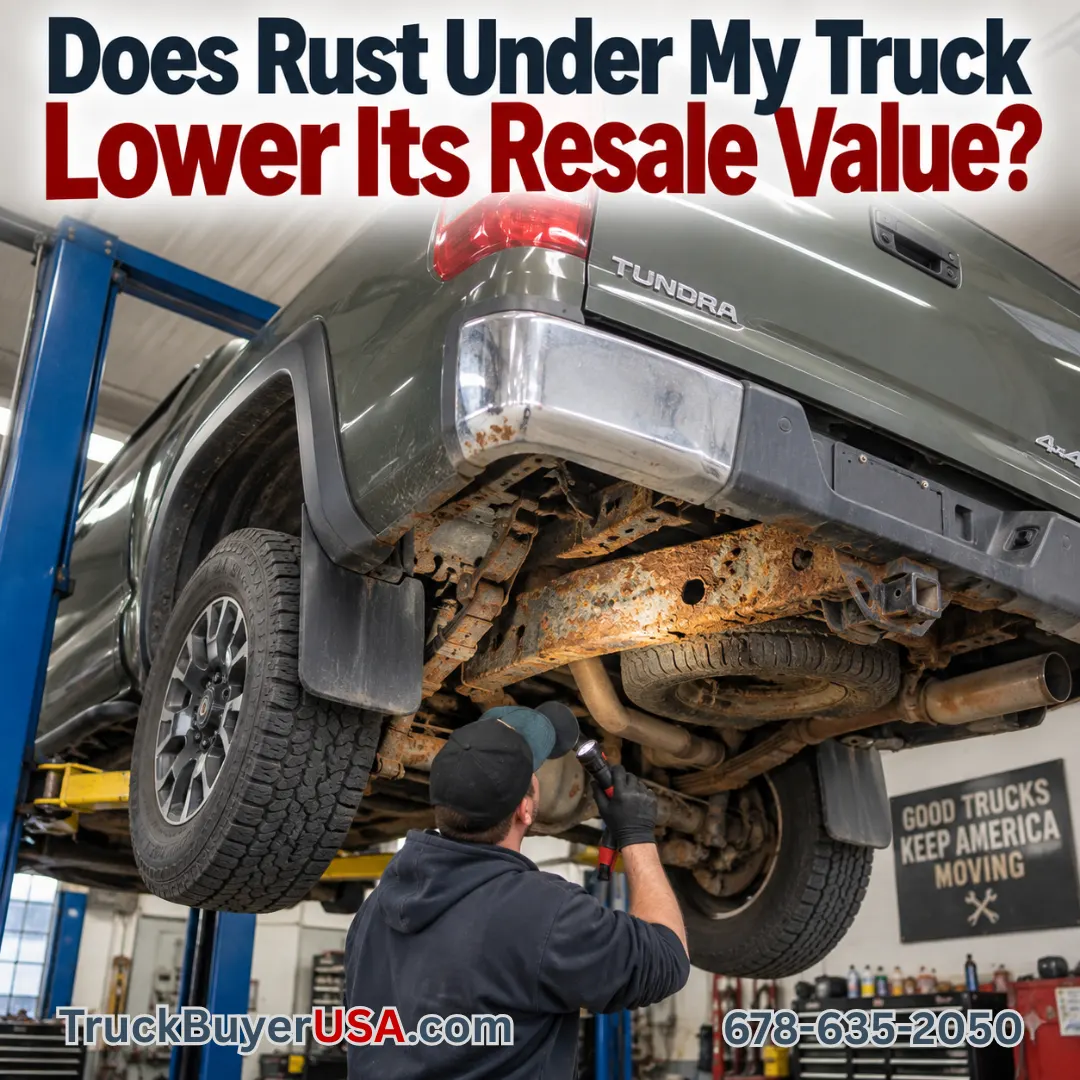
Rust underneath a truck is easy to ignore because most owners don't spend much time crawling around underneath their pickups. The paint may still look good, the engine may run beautifully and the truck may drive every day without a problem. Unfortunately, none of that means the underside is in equally good condition.

Yes, rust can absolutely lower your truck's resale value, and severe rust can lower it dramatically. The real question isn't simply whether your truck has rust. It's where the rust is, how advanced it has become and whether it has moved beyond cosmetic corrosion into structural deterioration.

A Little Rust Isn't the Same as a Rotten Truck

Some surface corrosion is fairly common on older trucks, particularly those that have spent years in areas where winter roads are treated with salt or deicing chemicals. Trucks also encounter mud, standing water and moisture that can remain trapped around frame rails, suspension components and body seams.

Light surface rust doesn't automatically destroy a truck's value. The situation becomes considerably more serious when metal begins scaling, flaking, swelling or deteriorating around structural areas. Once corrosion starts affecting the frame, crossmembers, suspension mounting points or other critical components, buyers aren't looking at an ugly cosmetic problem anymore. They're looking at the possibility of expensive repairs and potentially compromised structural integrity.

WHAT'S ACTUALLY RUSTING UNDER YOUR TRUCK?

What You See
What It Could Mean for a Sale
Light surface rust
Common on older trucks and may have limited effect on valure
Scaling or flaking corrosion
More advanced deterioration that deserves closer inspection
Rusted rocker panels/body mounts
May indicate corrosion extends beyond visible body panels
Corroded brake or fuel lines
Can create additional repair and safety concerns
Heavy frame corrosion
Can significantly reduce desirability and resale value
Frame perforation or holes
Serious structural damage that can dramatically affect value

When It's the Frame, Stop Calling It "Just Rust"

This is where truck owners need to be brutally realistic. Rust on a bumper, exhaust component or replaceable body panel isn't remotely the same issue as extensive corrosion in the frame.

A truck's frame is its structural foundation. When substantial corrosion develops around load-bearing areas, suspension mounting points or crossmembers, the problem can become far more expensive than simply cleaning up some ugly metal. A truck that looks excellent from the outside can still have serious deterioration underneath.

Trying to disguise advanced corrosion isn't a solution either. Heavy undercoating or fresh black paint applied over existing rust doesn't restore missing metal, and an experienced buyer may become even more cautious if it appears someone is attempting to hide what is underneath.

Don't Spend Thousands Fixing Rust Before Knowing What the Truck Is Worth

Discovering rust often sends owners straight into repair mode. Before long, they're pricing frame work, rocker panels, brake lines, welding, replacement components and undercoating. On an older or high- mileage truck, those repairs can quickly become difficult to justify.

Before authorizing thousands of dollars in work, find out what the truck is worth in its current condition. A rusty pickup isn't necessarily worthless. Its engine, transmission, drivetrain, year, mileage, trim, configuration and usable components can still contribute significant value.

That is especially important with older work trucks, farm trucks and pickups that have accumulated years of hard use. There comes a point when preserving a truck makes financial sense, and another point when you're simply pouring good money into disappearing metal.

Let TruckBuyerUSA Evaluate the Truck You Actually Have

If you've looked underneath your truck and discovered more rust than you expected, you don't necessarily need to restore it before you can sell it. You need to understand what it's worth right now. Start at TruckBuyerUSA.com and get an offer for the truck you actually own, rather than spending money trying to turn it into something it isn't. TruckBuyerUSA buys trucks nationwide in a wide range of conditions, which can give owners of rusty, aging or high-mileage pickups an alternative to expensive repairs or the headaches of finding a private buyer.

Be straightforward about the corrosion and the truck's overall condition. The rust may reduce its value, but that doesn't mean the truck has no value.

Before you pay to repair it, find out what TruckBuyerUSA may pay you to sell it as-is.

Does My Truck's Trim Level Matter When I Sell It?

- Friday, September 11, 2026

And Guessing Your Truck’s Trim Level Could Cost You Money!

TruckBuyerUSA - Does My Truck's Trim Level Matter When I Sell It?


Two trucks can be the same year, same make, same model and even have nearly identical mileage — yet they can be worth very different amounts. One of the reasons is trim level.

That little badge on the tailgate may represent thousands of dollars in equipment that separates a basic work truck from a luxury pickup. But here's where sellers sometimes get it wrong: a higher trim doesn't automatically guarantee a huge payday, and a lower trim doesn't automatically mean your truck isn't valuable. When you're ready to sell, the entire truck matters.

Trim Is More Than a Fancy Name on the Tailgate

Manufacturers use trim levels to package different combinations of engines, interiors, technology, towing equipment, suspension components and appearance features.

A basic Ford F-150 XL, for example, was designed for a very different buyer than an F-150 Platinum. The same applies to Chevrolet WT versus High Country, GMC Pro versus Denali, or Ram Tradesman versus Limited.

Those differences mattered when the truck was new, and many of them can still matter when it's time to sell.

Leather seating, upgraded infotainment, premium audio, larger wheels, advanced driver-assistance technology, four-wheel drive and factory towing equipment can all make one version of a truck more desirable than another.

But there's another side to the equation.

HOW TRIM CAN AFFECT YOUR TRUCK'S VALUE

Truck Factor
Why It Matters When Selling
Higher Trim Level
May include expensive equipment and luxury features buyers want
4WD / Off-Road Package
Can increase desirability depending on truck and market
Factory Tow Package
Useful equipment for buyers who actually use their trucks
Premium Interior
Leather, heated/cooled seats and technology may add appeal
Base / Work Trim
Can still be desirable for commercial, fleet and work use
Condition & Mileage
Can outweigh the advantage of having a higher trim

Don't Assume the Most Expensive Trim Is Always Worth More

This is where sellers need to be realistic. A loaded truck with 180,000 hard miles, accident damage, warning lights and a destroyed interior isn't automatically more valuable than a well-maintained lower- trim truck simply because it says Denali, Platinum or Limited on the back.

Condition matters. Mileage matters. Mechanical health matters. Accident history matters. Configuration matters. And demand matters. In fact, basic work-oriented trims have their own market. Contractors, businesses, farmers and buyers looking for an actual working pickup may care considerably more about capability, condition and reliability than leather seats or premium speakers.

Don't sell the badge. Sell the truck.

Know Exactly What You Own Before You Ask What It's Worth

If you're requesting an offer, don't guess at your trim. Look at your original paperwork, VIN information or manufacturer specifications. Trucks can have optional packages that aren't obvious from the exterior, and those options may matter when the vehicle is evaluated.

That is especially important if your truck has factory towing equipment, an upgraded engine, four-wheel drive, an off-road package or other desirable equipment. And don't assume you need to spend hundreds or thousands of dollars getting your truck ready to sell before finding out what it's worth.

Find Out What Your Truck Is Worth From TruckBuyerUSA

Whether you've got a loaded luxury pickup, a basic work truck, an older farm truck or something in between, TruckBuyerUSA wants to evaluate the truck you actually own — not just the badge attached to it.

Before spending money on repairs, detailing or upgrades you may never recover, go to TruckBuyerUSA.com and find out what your truck could be worth.

Your trim level matters, but so does everything attached to it.

Get the value first. Then decide whether keeping that truck still makes sense.

Where Can I Sell My Truck Without Trading It In?

- Thursday, September 10, 2026

You Don't Have to Surrender Your Truck to the Same Dealer Selling You Your Next Vehicle

TruckBuyerUSA - Where Can I Sell My Truck Without Trading It In?


You're buying another vehicle, so you drive your truck to the dealership, negotiate the new vehicle, hand over the keys to your old truck and call it a trade-in. That's how it's supposed to work, right? Not necessarily.

You can sell your truck without trading it in at all. And separating the sale of your truck from the purchase of your next vehicle can make it much easier to see exactly what you're getting for your pickup.

A trade-in is convenient, but convenience shouldn't stop you from finding out what someone else will pay before you sign over a truck potentially worth tens of thousands of dollars.

Your Truck and Your Next Vehicle Are Two Different Deals

Trade-ins can get confusing because there are so many numbers moving around at once: the price of the new vehicle, trade allowance, loan payoff, equity, dealer fees, financing, down payment and monthly payment.

Before long, you're staring at a worksheet that practically requires an accounting degree. Strip everything down and there are two separate questions: What am I paying for the next vehicle, and what am I getting for my truck? Knowing your truck's value before negotiating another vehicle gives you an independent number to compare against the dealer's trade offer.

A Trade-In Offer Is Just One Offer

If a dealership offers $25,000 for your truck, that doesn't automatically mean $25,000 is all someone else might pay.

Dealers value trades according to their own needs. Your truck might go onto their used lot, move to another location, be wholesaled or eventually head to auction. Mileage, condition, equipment and local demand can all influence their number. That doesn't mean every trade-in offer is bad. It means you shouldn't assume the first number is the only number.

If you're selling an asset worth thousands of dollars, getting another offer before handing over the keys is simply smart comparison shopping.

Don't Let the Monthly Payment Hide Your Truck's Value

It's easy to become focused on one number at the dealership: "What's my monthly payment?"

But that payment doesn't tell you whether you received a strong price for your truck. Loan term, interest rate, purchase price, down payment, incentives and trade equity can all change the monthly figure.

Keep the important numbers separate:

KNOW THIS NUMBER
WHY IT MATTERS
Vehicle purchase price
What you're actually paying
Truck loan payoff
What you still owe
Dealer trade offer
What the dealer is offering
Independent truck offer
Gives you something to compare
Truck equity
What may remain after payoff

The goal is simple: know what you're paying for one vehicle and what you're receiving for the other.

You Can Sell Your Truck Without Buying Anything

Maybe you're downsizing, getting rid of an extra work truck or simply don't need a pickup anymore. You don't have to buy another vehicle to sell the one you own.

Selling separately allows your truck to stand on its own transaction. If there's a loan, the payoff must be handled. If it's paid off, there's no lender balance coming out of the proceeds. Either way, you decide what happens to the money instead of automatically rolling your truck's value into another purchase.

Don't Trade Your Truck Until You Get an Offer From TruckBuyerUSA

Before your truck becomes another number buried inside a dealership deal, get an offer from TruckBuyerUSA.

Our team gives you another way to sell your pickup directly without buying another vehicle or negotiating a trade allowance at the same time.

Replacing your pickup? Downsizing? Selling an extra work truck? Just ready to turn that truck into cash?

Start at TruckBuyerUSA.com and find out what we will pay before accepting a dealer's trade-in number. Then compare your options.

Your truck is a separate asset. Treat it like one. Don't automatically trade it away for convenience. Get your TruckBuyerUSA offer first.

How Much Is My Truck Worth With 150,000 Miles?

- Wednesday, September 09, 2026
TruckBuyerUSA - How Much Is My Truck Worth With 150,000 Miles?

150,000 Miles Is a Big Number. It Doesn't Automatically Mean a Small Offer.

Your odometer just rolled past 150,000 miles, and suddenly you're looking at your truck a little differently.

Yesterday it was your dependable pickup. Today, that six-digit odometer is staring back at you like you've committed some terrible resale-value crime.

So, how much is a truck with 150,000 miles actually worth? Potentially more than you think.

There is no magic mileage switch that flips at 150,000 and turns a pickup into a $2,000 beater. Mileage absolutely matters when determining value, but it's only one part of the equation. The make, model, year, engine, drivetrain, configuration, condition, maintenance history and current demand for your particular truck can all affect what someone is willing to pay.

In other words, 150,000 miles tells us how far your truck has traveled. It doesn't tell us the whole story of what it's worth.

Not All 150,000-Mile Trucks Are Created Equal

Consider two trucks with exactly the same mileage.

One has been maintained, starts immediately, shifts properly, has a clean interior and hasn't spent the last decade being treated like a battering ram. The other has warning lights glowing across the dashboard, bald tires, questionable transmission behavior and an interior that looks like three construction crews and a Labrador have been living in it.

Same mileage. Very different trucks.

Truck buyers know this, which is why mileage alone doesn't determine value. A well-maintained pickup with 150,000 miles may still have plenty of usable life ahead of it, especially if it's a model with strong demand in the used-truck market.

What Actually Determines the Value?

Several factors can make a substantial difference once a truck reaches higher mileage.

VALUE FACTOR
WHY IT MATTERS
Make and model
Demand varies significantly between trucks
Gas vs. diesel
Engine type can affect demand and expected service life
2WD vs. 4WD
Drivetrain can influence desirability
Overall condition
Drivetrain can influence desirability
Maintenance history
A cared-for truck tells a different story
Cab and bed configuration
Certain combinations may attract more buyers
Accident history
Previous damage can affect value
Location and market demand
Truck demand isn't identical everywhere

This is also why comparing your pickup to three random online listings isn't necessarily going to tell you what yours is worth. Asking prices aren't selling prices, and another truck that looks identical in a photograph could have a completely different history.

The Bigger Question: What Happens at 175,000 or 200,000 Miles?

Here's where owners of high-mileage trucks need to pay attention.

If you're already considering selling at 150,000 miles, what exactly are you waiting for?

Another 25,000 miles probably isn't going to make the truck younger. Crossing 175,000 or eventually 200,000 miles isn't likely to improve its condition, and during that time you're still paying for maintenance, tires, brakes, repairs, insurance and everything else that comes with keeping an aging pickup on the road.

Then there's the repair wildcard.

At higher mileage, a single expensive mechanical problem can completely change the selling conversation. Instead of asking, “What's my running truck worth with 150,000 miles?” you could eventually be asking, “What's my 175,000-mile truck worth with a bad transmission?”

That's a very different question.

Don't Spend Thousands Trying to Make It a 50,000-Mile Truck Again

Another mistake is assuming you need to fix every imperfection before selling.

Maybe the bumper has a dent. The seat is worn. The tires aren't brand new. The paint has accumulated 150,000 miles worth of evidence that your truck has actually been driven. It's a used truck. Buyers expect some wear.

Before dumping serious money into repairs or cosmetic work solely because you think it will dramatically increase the selling price, find out what the truck is worth as it sits today. Spending $4,000 on repairs does not automatically add $4,000 to the value.

150,000 Miles Doesn't Mean You Missed Your Chance to Sell

If your truck has 150,000 miles, don't assume nobody wants it and don't automatically drive it into the ground because you believe its value is already gone.

Find out what it's actually worth.

Team TruckBuyerUSA understands that 150,000 miles can mean very different things depending on how a pickup has spent its life. It might be a farm truck that's hauled feed, fencing and equipment for years, a work truck that's earned every mile on the odometer, or simply a dependable daily driver that's been kept on the road long enough to rack up six figures.

Whatever put those miles there, don't assume your truck has aged out of the selling market. We will evaluate higher-mileage pickups in their current condition and help you determine what yours may be worth today. Before you add another 25,000 miles—or another season of hard work—visit

TruckBuyerUSA.com and get a real value for the truck you already own.

Because 150,000 miles may sound like a lot.

But discovering you could have sold it before the next major repair bill might sound a whole lot better.

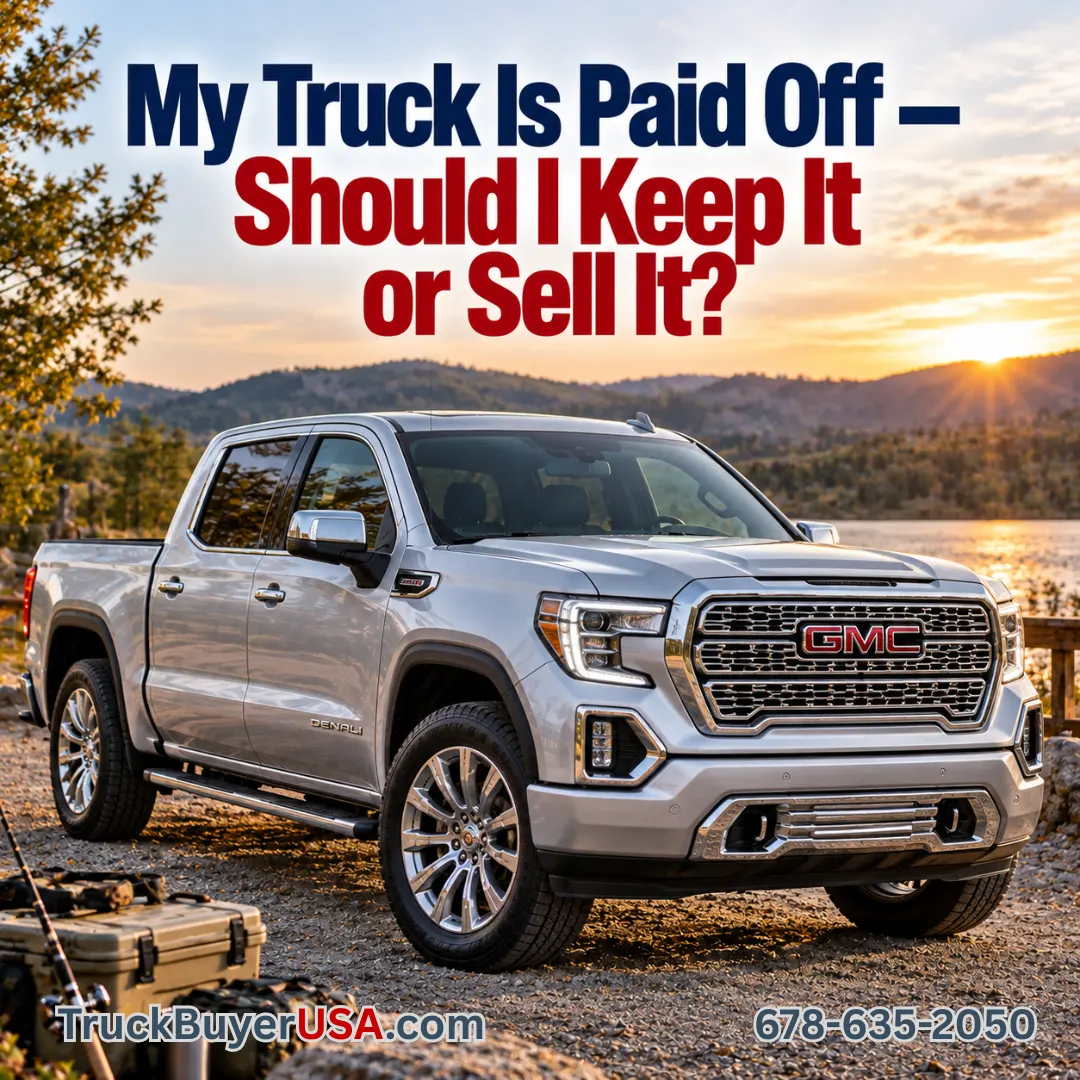
My Truck Is Paid Off — Should I Keep It or Sell It?

- Tuesday, September 08, 2026
TruckBuyerUSA - My Truck Is Paid Off — Should I Keep It or Sell It?


There is something incredibly satisfying about making that final truck payment. After years of watching hundreds of dollars leave your bank account every month, the loan balance finally hits zero. The truck is yours, the lender is out of the picture and suddenly you've got a vehicle sitting in the driveway without a monthly payment attached to it.

That feels pretty good, and it should. But it also creates an interesting question: Does owning a paid-off truck automatically mean you should keep it?

Not always. A paid-off truck can be one of the smartest vehicles to keep, particularly if it's reliable and you use it regularly. But if the truck isn't serving the same purpose it once did, repairs are starting to creep up or you've already been thinking about selling, "but it's paid off" shouldn't be the only reason it stays in your driveway.

Paid Off Doesn't Mean Free

Getting rid of the payment doesn't eliminate the cost of owning the truck. You're still paying for insurance, registration, fuel, tires, brakes, routine maintenance and whatever mechanical surprise decides to introduce itself next.

As the truck gets older, those expenses can become more important. At the same time, additional mileage and age can affect what someone is willing to pay for it. That doesn't mean your truck suddenly becomes worthless once the loan disappears. In fact, depending on its age, mileage, condition, configuration and market demand, there could still be a significant amount of money sitting in your driveway.

The question becomes whether you'd rather continue getting value from the truck by driving it or capture some of its remaining value by selling it.

Do You Still Need a Pickup Truck?

This is where the decision can get surprisingly simple.

Maybe you originally bought the truck because you needed to tow a trailer, haul equipment or use it for work. Perhaps you owned a camper, boat or property that made having a pickup practically mandatory. Years later, your situation may look completely different.

If the trailer is gone, your job changed and the most demanding hauling assignment your truck gets these days is bringing home six bags of mulch from Home Depot twice a year, you might want to reconsider whether you still need thousands of dollars tied up in a pickup.

Of course, if you use the truck constantly, it's dependable and you would immediately have to buy another truck to replace it, keeping it could make excellent financial sense. Trading a reliable paid-off vehicle for a shiny new payment isn't automatically an upgrade.

Keeping It vs. Selling It

The decision becomes clearer when you look at how the truck fits your life today rather than how it fit your life when you bought it.

KEEP THE TRUCK
CONSIDER SELLING
You use it regularly
It spends most of its time parked
It's reliable
Repairs are becoming frequent
It's reliable
Repairs are becoming frequent
Maintenance costs are reasonable
Expensive maintenance may be approaching
You still need to tow or haul
You rarely use its truck capabilities
You plan to drive it for years
You've already considered replacing it
Avoiding another payment is important
You'd rather turn its value into cash

There's no universal answer. A paid-off truck that costs relatively little to own and still does everything you need can be extremely valuable transportation. But a paid-off truck you barely drive can become an expensive piece of driveway furniture.

Don't Wait Until a Repair Bill Makes the Decision

One of the advantages of considering a sale while your truck is still running well is that you get to make the decision on your terms.

Wait long enough and the truck may eventually participate in the discussion.

Maybe it's a transmission problem, diesel emissions system repair, air-conditioning failure, suspension work or another major mechanical issue. Throw in a set of tires and brakes around the same time and suddenly your wonderful payment-free truck is asking for several thousand dollars.

That doesn't mean you should panic and sell a perfectly good truck because something might eventually break. Vehicles require maintenance. But if your truck is getting older, accumulating substantial mileage and no longer being used much, it makes sense to compare its current value with what you're likely to spend keeping it.

Find Out What Your Truck Is Worth Before You Decide

This is where many owners make the mistake of guessing. They assume an older truck isn't worth enough to bother selling, or they remember what the truck was worth several years ago and assume the number hasn't changed much.

Instead, get a current offer and make the decision with an actual dollar amount in front of you.

TruckBuyerUSA can evaluate your pickup and give you an opportunity to see what it's worth in today's market. Whether you own a gas pickup, diesel, work truck, heavy-duty truck or an older high- mileage pickup, knowing its current value gives you something far more useful than speculation.

And because your truck is already paid off, there's no outstanding loan balance that has to be satisfied from the sale proceeds. If you decide to sell, the equity isn't going toward paying off a lender first.

Visit TruckBuyerUSA.com and find out what your paid-off truck could be worth. You don't have to sell simply because you request an offer. You may look at the number and decide you'd rather keep driving your truck for another five years.

Or you may look out the window at the pickup that's been sitting there all week and realize something else:

Maybe being paid off isn't the best reason to keep it.

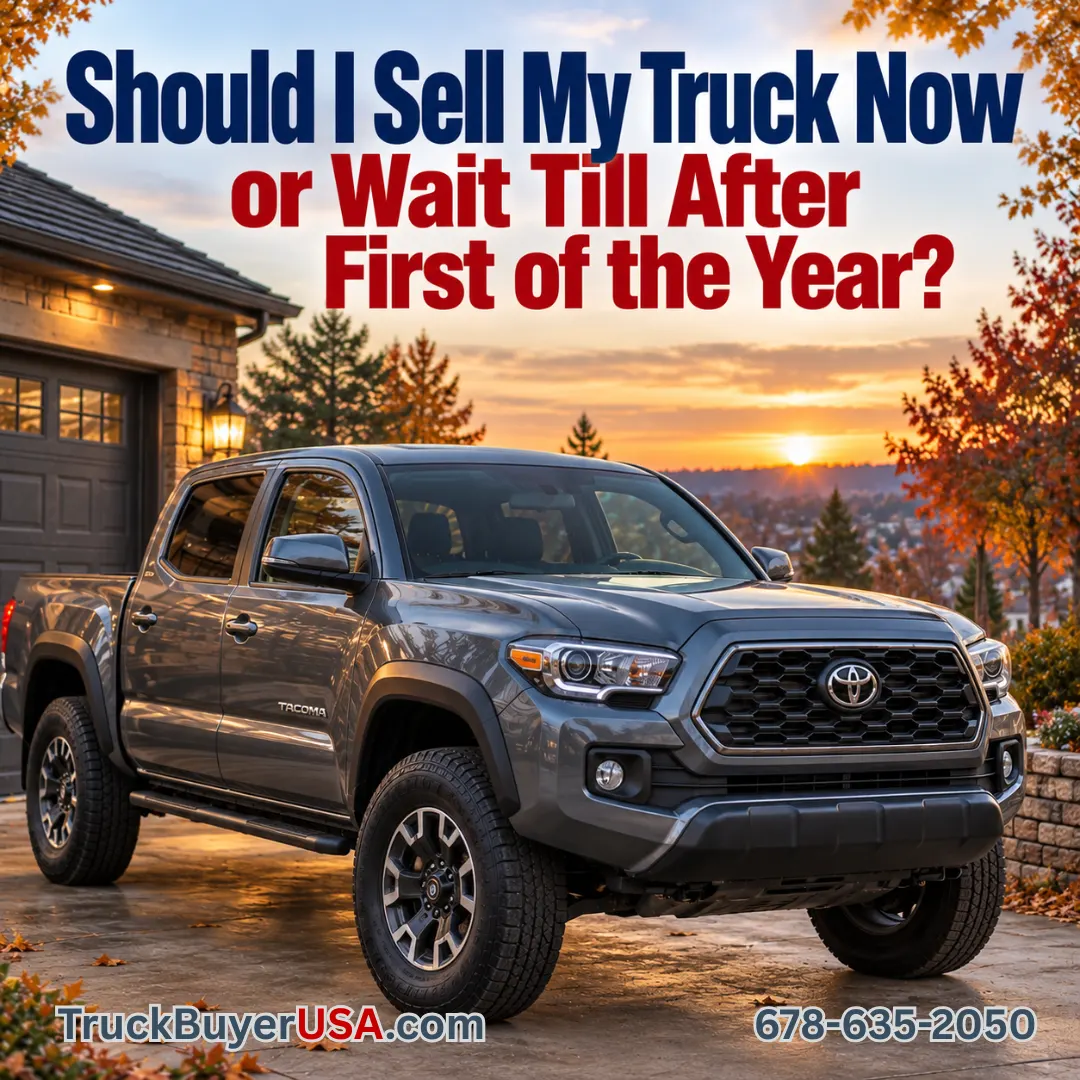
Should I Sell My Truck Now or Wait Till After the First of the Year?

- Friday, September 04, 2026
TruckBuyerUSA - Should I Sell My Truck Now or Wait Till After the First of the Year?

If You're Already Thinking About Selling, Waiting for January Doesn't Automatically Mean More Money It's a question plenty of pickup owners start asking as the end of the year gets closer: Should I sell my truck now, or would I be better off waiting until after January 1?

It sounds logical that a new year might bring a fresh market, more buyers and possibly a better price. But here's the problem: while the calendar is waiting to flip, your truck isn't getting any newer.

It's gaining mileage. Another model year is arriving. You may have another registration renewal, insurance payment, maintenance bill or repair coming. And the used-truck market can move in either direction. So before deciding to wait, it's worth looking at what you're actually waiting for.

January Doesn't Make Your Truck a Year Younger

Once the new model year is firmly on the market, buyers naturally start comparing older trucks against newer inventory. Your 2021 pickup doesn't suddenly become undesirable on January 1, but its age isn't moving in your favor either.

Mileage matters, too. If you're sitting at 78,000 miles now and expect to put another 5,000 or 8,000 miles on the truck over the next several months, waiting could affect what a buyer is willing to pay. And if you're approaching a major mileage milestone — 75,000, 100,000, 150,000 or beyond — that can become another reason to at least find out what the truck is worth before you cross it.

What Are You Hoping Will Happen After January 1?

That's really the question! If you need the truck through the holidays or for winter work, waiting may make perfect sense. If you're planning to replace it early next year, keeping it a little longer may also be the practical choice.

But if you're waiting simply because you assume trucks will automatically be worth more after New Year's Day, that's a gamble.

If You Sell Now
If You Wait
Lock in today's truck value
Market value could rise or fall
Avoid adding more mileage
Truck continues accumulating miles
Avoid potential upcoming repairs
Maintenance and repairs remain your responsibility
Eliminate insurance/payment costs sooner
Continue paying ownership expenses
Know exactly what you can get today
Hope the future offer is better

Don't Try to Predict the Market — Get a Number

Here's where the decision gets much easier. You don't have to sell your truck today just because you're thinking about it. Find out what it's worth today!

Once you have an actual number in front of you, you can make a much smarter decision. Maybe the current value is high enough that selling now makes sense. Maybe you decide you'd rather keep driving it for another few months. Either way, you're making the decision with information instead of guessing what January might bring.

That's especially important with pickups because value can vary dramatically depending on the truck. A diesel HD work truck, half-ton crew cab, older high-mileage pickup and late-model luxury truck aren't necessarily going to behave the same way in the resale market.

So, Should You Sell Now or Wait Until After the First of the Year?

If you're still using and enjoying your truck, there's no reason to rush simply because the calendar is changing. But if you've already been thinking about selling, waiting for January just because it's January may not accomplish anything.

Your truck will be older. It may have more miles. You may spend more money maintaining, insuring and financing it. And there's no guarantee the market will reward you for waiting. Before you roll the dice on next year's value, see what your truck could bring right now.

Visit TruckBuyerUSA.com and get a price for your pickup. You might discover that the best time to sell isn't after the first of the year.

It might be before everybody starts singing “Auld Lang Syne.”

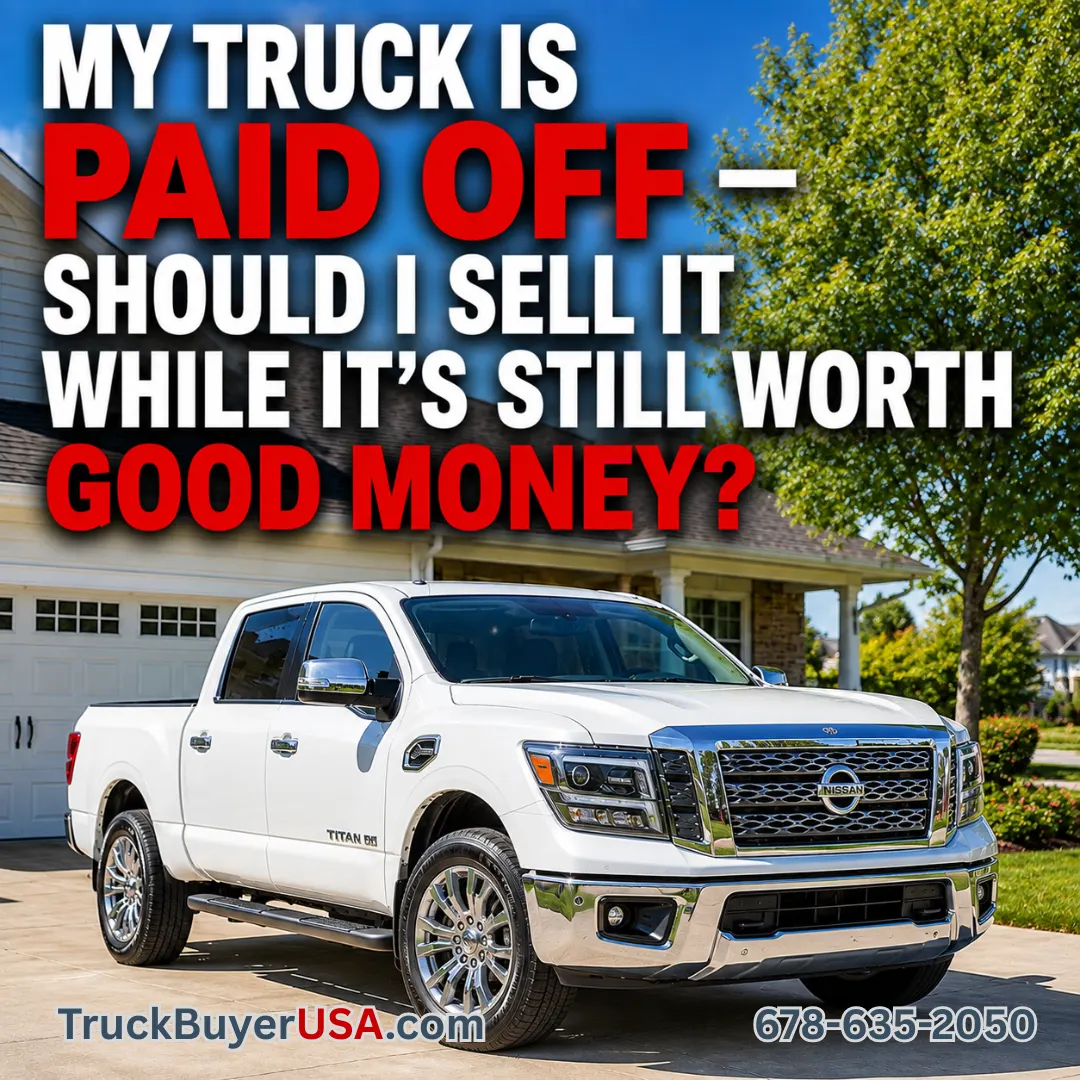
My Truck Is Paid Off — Should I Sell It While It’s Still Worth Good Money?

- Wednesday, September 02, 2026
TruckBuyerUSA - My Truck Is Paid Off — Should I Sell It While It’s Still Worth Good Money?


You did it!! After years of monthly payments and interest charges, your truck is finally paid off. No lender. No giant withdrawal every month. The truck sitting in your driveway belongs completely to you. So why would you sell it now? For plenty of owners, keeping a reliable paid-off pickup is a smart financial decision. If you love the truck, use it regularly and plan to drive it for years, enjoy life without a truck payment.

But there's another side worth considering: Your paid-off truck may also represent a substantial amount of money sitting in your driveway. If you've already thought about selling, now might be a good time to find out exactly how much.

Paid Off Doesn't Have to Mean "Keep Forever"

Maybe your life has changed since you bought the truck. You don't tow anymore. You barely use the bed. The kids are gone. You work from home. Or there's another vehicle in the household getting most of the miles.

Suddenly, "But it's paid off!" may be the biggest reason you're keeping it. That's when it's worth looking at the numbers.

KEEP THE TRUCK OR CASH OUT?

If This Sounds Like You...
Think About...
You love it and drive it regularly
Enjoy having no payment
You plan to keep it for years
Keeping it may make perfect sense
You barely drive it
Why keep that much value parked?
You barely drive it
Why keep that much value parked?
You don't need a truck anymore
Consider converting it to cash
You'll probably sell within 1–2 years
Find out what it's worth now
Expensive repairs may be approaching
Get a value before spending thousands

Your Truck May Be Worth More Than You Think

Depending on its year, model, mileage, configuration and condition, a paid-off pickup could still represent tens of thousands of dollars in value.

And here's the important difference: there's no big loan balance waiting to consume the proceeds. If your truck is worth $30,000 and you owe nothing, that's potentially $30,000 in an asset you completely own.

Now the question becomes much more interesting:

  • Would you rather have the truck—or the money?

Don't Sell Just to Create Another Huge Payment

We're definitely not suggesting everyone should sell a perfectly good paid-off truck and immediately finance another expensive one. That could defeat the entire purpose.

But maybe you're downsizing. Maybe you already have another vehicle. Perhaps you don't need a pickup anymore. Or maybe you'd rather put that money toward debt, savings, another vehicle or something else that's more important to you now.

Selling doesn't have to mean replacing your truck with another $70,000 truck. Sometimes it simply means your needs have changed.

Find Out Before You Decide

You don't have to decide today whether your truck stays or goes.Start with the number.

TruckBuyerUSA buys trucks nationwide and can help determine what your pickup may be worth based on its year, mileage, configuration and condition.

Once you know what someone is willing to pay, you can make the decision that works for you. Maybe you look at the offer and say, "Nope. I'm keeping my truck." Great. Enjoy having no payment. But if you discover there's $20,000, $30,000 or considerably more sitting in a truck you rarely use, you may feel very differently.

You spent years making payments so you could finally own that truck.

Now you get to decide what you'd rather own:

The truck—or the money it's worth.

Find out what TruckBuyerUSA.com will pay before you make the call.

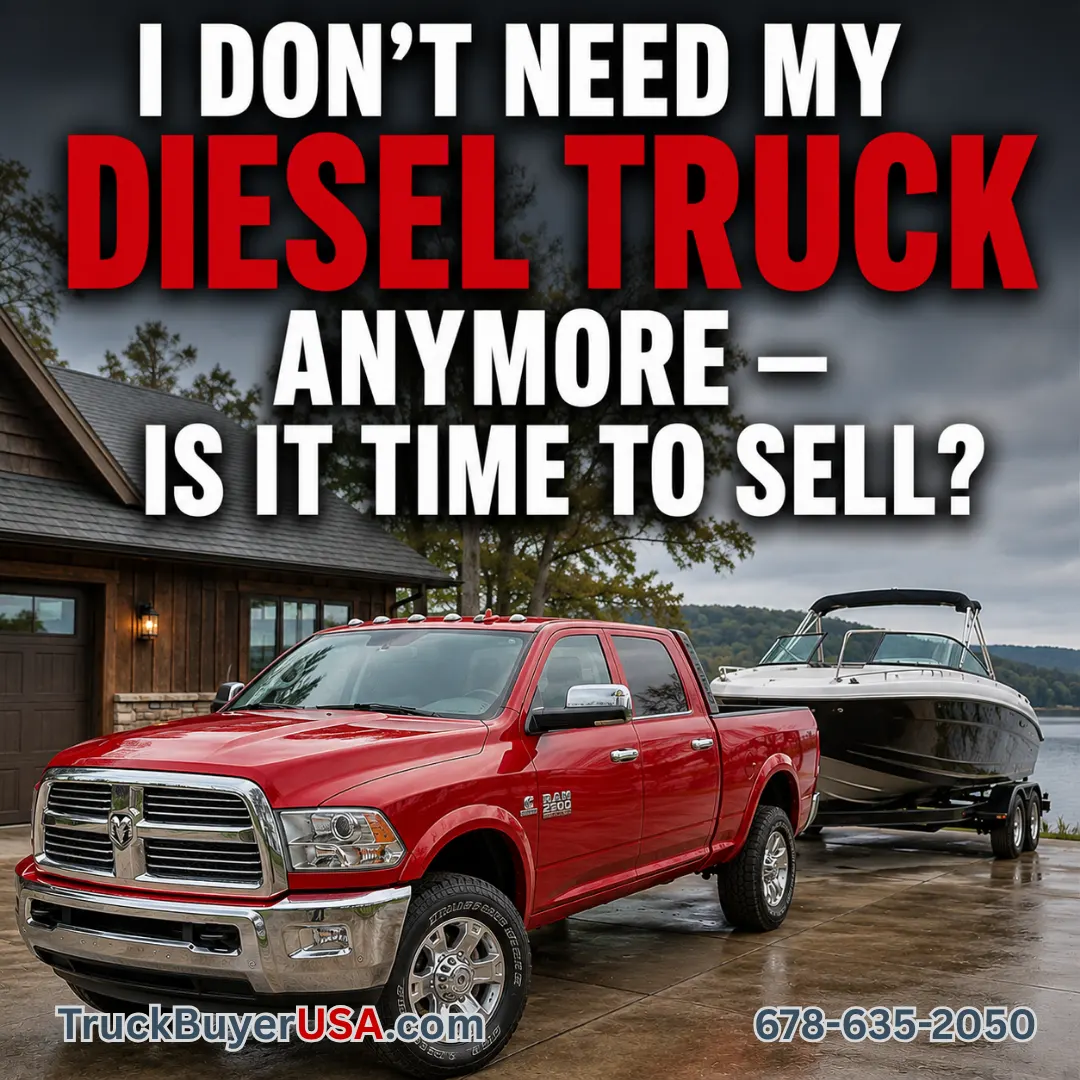
I Don't Need My Diesel Truck Anymore — Is It Time to Sell?

- Monday, August 31, 2026
TruckBuyerUSA - I Don't Need My Diesel Truck Anymore — Is It Time to Sell?


There was a reason you bought the diesel. Maybe there was a 38-foot fifth wheel behind it every summer. Maybe you had a big boat, horse trailer, toy hauler or some serious towing to do. You wanted the torque, capability and confidence of a diesel pickup—and you actually used it.

Then something changed. The RV was sold. The boat disappeared. The kids aren't interested in camping anymore. You stopped towing. Or maybe life simply moved into a different chapter. Now that big diesel is still sitting in the driveway, perfectly capable of pulling thousands of pounds... and you're using it to go to the grocery store.

There's nothing wrong with keeping a diesel pickup because you love it. But if the primary reason you bought one no longer exists, it might be worth asking a different question:

Do I still need to own it?

Diesel Capability Isn't Free

Diesel pickups can be incredible machines, particularly when they're being used for what they were designed to do. But that capability comes with ownership costs.

Depending on the truck, those can include more expensive maintenance, larger quantities of oil, fuel filters, emissions-system components, heavy-duty tires and potentially expensive repairs as the vehicle ages.

  • If you're towing regularly, those expenses may simply be part of owning the right equipment.
  • If you're driving eight miles to the grocery store?
  • You may be paying for a whole lot of truck you're no longer using.

DO YOU STILL NEED YOUR DIESEL?

Why You Bought It
What's Happening Now
Towing a fifth wheel
RV was sold
Pulling a large boat
Boat is gone
Hauling a horse trailer
No longer hauling
Frequent long-distance towing
Mostly local driving
Needed serious torque
Rarely tow anything
Planned years of RV travel
Plans changed
“I'll always need a diesel”
Maybe you don't

None of this means buying the diesel was a mistake. It did its job. Your needs changed. That's a very different thing.

Don't Wait for a Huge Repair Just Because the Truck Is Paid For

Here's where the decision can become more complicated. If your diesel is paid off, keeping it can feel like the obvious choice. No monthly truck payment is certainly attractive.

But “paid off” doesn't mean “free.” An aging diesel may eventually need expensive maintenance or repairs. That doesn't mean something catastrophic is guaranteed to happen, and plenty of properly maintained diesel pickups accumulate substantial mileage.

The question is whether you still want to assume those future ownership costs for capability you're no longer using.

If you've already been thinking, I'll probably sell it eventually, it may be worth finding out what it's worth before “eventually” turns into another 40,000 miles and several more years.

Your Diesel May Be More Valuable to Someone Else

Here's the other side of the equation...You may not need your diesel anymore, and someone else absolutely might. A buyer pulling a fifth wheel, horse trailer, large boat or heavy equipment may specifically be looking for the towing capability, configuration and engine your truck already has. That's why you shouldn't automatically assume an older or higher-mileage diesel isn't worth much. Mileage matters, but so do the truck's year, engine, drivetrain, cab configuration, 4x4 capability, trim, maintenance history and overall condition.

Find out what it's worth before deciding it's too old to sell.

Should You Downsize?

Maybe. If most of your driving now consists of commuting, errands and highway trips without a trailer attached, you may discover that a smaller pickup—or even something other than a truck—fits your current life better.

You could potentially reduce fuel consumption, maintenance expenses and other ownership costs while converting the value sitting in your diesel into money you can use somewhere else. But we're not going  to tell you that you should sell it and that's your decision.

TruckBuyerUSA can simply help you get the information you need to make it.

Find Out What TruckBuyerUSA Will Pay

If the trailer hitch hasn't seen a trailer in two years, take a good look at that diesel sitting in your driveway. Maybe you still love it and want to keep it forever. Great.

But if you've caught yourself wondering why you're still driving a heavy-duty diesel when you no longer tow or haul anything substantial, find out what TruckBuyerUSA will pay for it.

TruckBuyerUSA.com buys trucks nationwide and evaluates diesels with different ages, mileages, configurations and conditions.

  • You don't need to wait until something breaks.
  • You don't need to trade it toward another $70,000 truck.
  • And you certainly don't need to apologize for changing your mind.

Your diesel did what you bought it to do.

Maybe now it's time to let it do that job for somebody else—and put its remaining value back in your pocket.

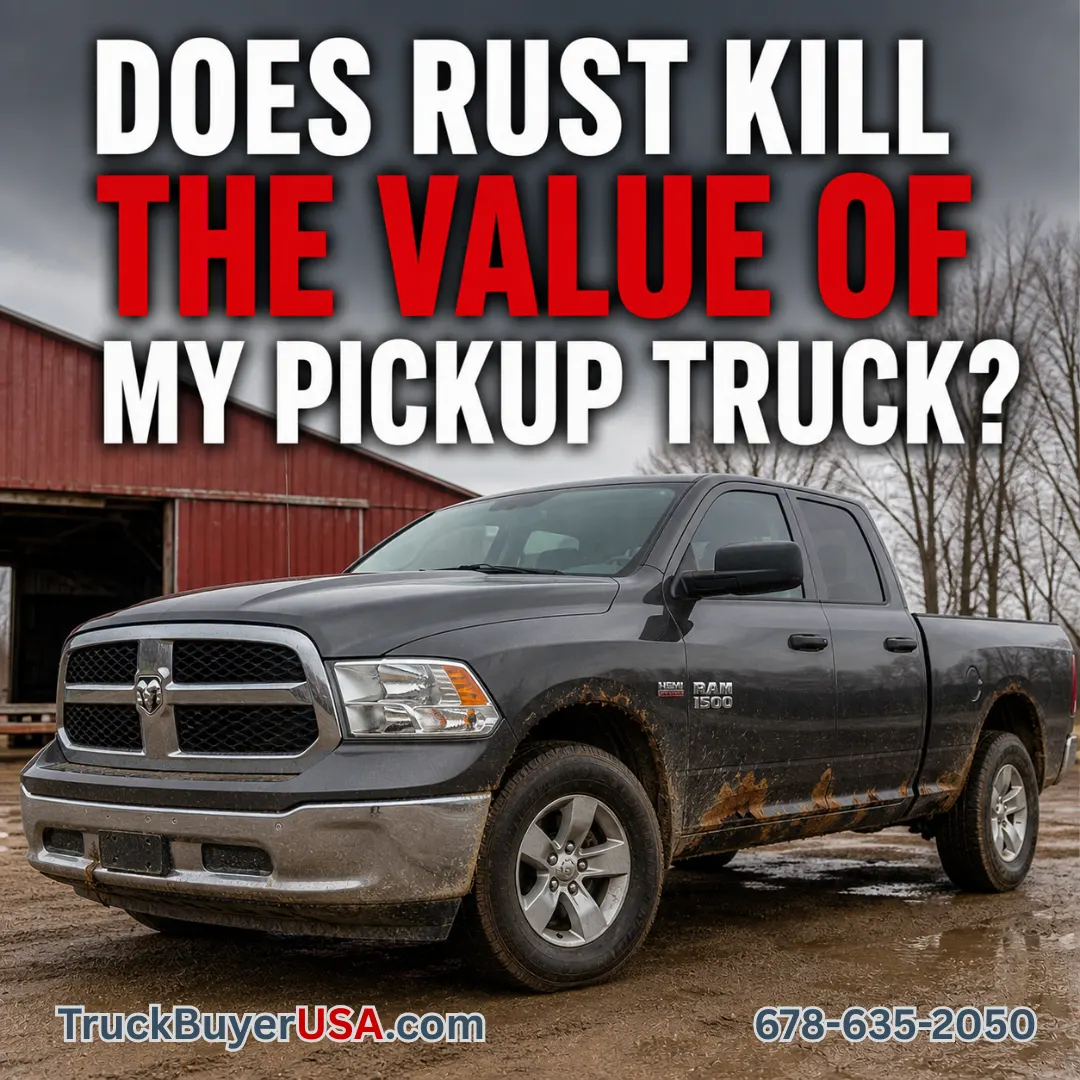
Does Rust Kill The Value Of My Pickup Truck?

- Thursday, August 27, 2026
TruckBuyeUSA - Does Rust Kill The Value Of My Pickup Truck?


You spot a little rust along the bottom of your pickup. Then you look underneath. Uh-oh. There's more. Now you're wondering whether that truck you've owned for years is still worth decent money—or whether the sight of rust automatically sends its value straight to the scrapyard.

Here's the good news: rust does not automatically kill the value of a pickup truck.

The not-so-good news? There is a very big difference between a little surface rust and serious structural corrosion. Before spending thousands trying to repair it—or assuming nobody will buy it—it's important to know what you're actually dealing with.

Not All Rust Is the Same

Pickups are particularly vulnerable to corrosion because of where and how they're driven. Rain, snow, mud, humidity and especially years of road salt can take a toll on exposed metal underneath a truck. Light surface rust may look terrible without necessarily being a major problem. You might see discoloration on suspension components, brackets, bolts or portions of the underbody while the truck itself remains structurally sound.

Heavy corrosion is different.

When rust progresses to significant scaling, flaking, holes or deterioration of structural components, it can substantially affect the truck's value. Severe frame corrosion can also become a safety issue and should be professionally evaluated.

So when someone says, “My truck has rust,” our next question should really be: What kind and how much?

HOW MUCH CAN RUST MATTER?

What You See
Potential Effect on Value
Light surface discoloration
Often relatively minor
Typical underbody surface rust
May be expected on older trucks
Visible body-panel rust
Cosmetic condition can reduce value
Bubbling paint or spreading corrosion
May indicate deterioration underneath
Heavy scaling or flaking
More significant value concern
Serious frame corrosion or holes
Can substantially reduce value

Two trucks of the same year, model and mileage can therefore have very different values. One may have ordinary age-related surface corrosion while the other has deterioration that affects important structural areas. Simply seeing orange underneath your truck doesn't tell the whole story.

Should You Repair the Rust Before Selling?

This is where owners sometimes turn a value problem into a spending problem.

You discover rust and immediately start pricing bodywork, replacement panels, rust treatments, frame repairs or professional restoration. Before long, you're considering spending several thousand dollars on a truck you were already thinking about selling. But will a $3,000 repair make the truck worth $3,000 more?

Not necessarily.

Before authorizing expensive repairs, find out what the pickup is worth in its current condition. You may discover that selling it as-is makes considerably more financial sense.

And if the corrosion is significant, don't try to conceal it with fresh paint or a heavy coat of undercoating. Be straightforward about the condition so the truck can be evaluated properly.

Rust Doesn't Make the Rest of Your Truck Disappear

A rusty pickup can still have substantial value. Engine, transmission, drivetrain, configuration, mileage, trim level, options, maintenance history, interior condition and overall desirability all contribute to what a truck is worth.

A four-wheel-drive diesel pickup with desirable equipment, for example, doesn't suddenly become worth zero because corrosion has appeared underneath it. Rust becomes another part of the valuation. How serious that part is depends on the truck.

Where Your Truck Lived Matters, Too

A pickup that's spent ten winters driving on salted roads may look very different underneath from an identical truck that's spent its entire life in a dry climate.

Buyers familiar with trucks from snow-belt states may expect to see some corrosion. What matters is whether that rust is normal age-related deterioration or something considerably more serious. That's why clear photographs and an accurate description can be far more useful than simply saying, “It's a little rusty.”

Before You Spend Money, Let TruckBuyerUSA Look at the Truck

If you're considering selling your pickup and rust has you worried, don't automatically assume you've lost your chance to get a good offer.

And don't automatically start repairing everything you see.

TruckBuyerUSA.com buys trucks nationwide and evaluates pickups in many different conditions. Be upfront about the rust, show us what you're dealing with and find out what your truck may be worth as-is. Once you know that number, you can decide whether repairing the rust makes sense—or whether you'd rather sell the truck and let someone else deal with it.

Because rust can absolutely affect the value of a pickup truck. But a little orange underneath doesn't automatically mean your truck isn't worth some serious green.


How It Works

We Buy Any Truck in any condition, anywhere in the Continental USA.

1 Get an Instant Cash Offer
Enter the Year, Make, Model, Trim Level & Miles (No VIN Required) and your cash offer appears onscreen (94% of the time)
2 Accept your offer
TruckBuyerUSA offers are Cash Market Value. Funds are guaranteed and paid at the time of pickup or drop-off
3Talk to an Agent
Your TruckBuyerUSA representative schedules a no obligation mobile inspection - TruckBuyerUSA comes to you. Digital purchase agreement takes less than 60 seconds to complete.
4 Get Paid
When TruckBuyerUSA picks up your truck, you are paid on the spot in full with guaranteed funds – entire process is hassle free. Inspection, title work & pick up are all FREE.

Onscreen Quote in seconds No Personal Info Required