Sell Your Truck
Fast, Safe & Easy

No Hassles. We Come To You.
888-724-2058

Is My Truck Worth More With a Long Bed or Short Bed?

- Tuesday, October 13, 2026

When It Comes to Truck Beds, Longer Doesn't Automatically Mean More Money!

TruckBuyerUSA - Is My Truck Worth More With a Long Bed or Short Bed?


You've got a pickup with a long bed. Your neighbor has the same truck with a short bed. Same year, similar mileage and comparable condition. So which one is worth more when it's time to sell?

You might assume the longer bed wins because it carries more cargo. After all, more truck should mean more money, right? Not necessarily. Bed length can influence resale value, but buyer demand, vehicle configuration and intended use determine whether those extra feet actually translate into extra dollars.

Long Beds: Built for Buyers Who Mean Business

Long-bed pickups, often around eight feet in full-size trucks, offer valuable cargo space for lumber, construction materials, farm supplies and bulky equipment. Contractors, agricultural operations and commercial fleets may specifically seek these configurations. Combined with the right engine, drivetrain and towing equipment, a long-bed pickup can be highly desirable.

But there's a downside. Longer trucks require more parking space and can be harder to maneuver. For buyers who rarely haul anything substantial, that additional length may be an inconvenience rather than an advantage. More cargo space doesn't automatically mean a higher selling price.

Short Beds: Less Length, Plenty of Appeal

Short-bed pickups often appeal to everyday drivers who want truck versatility without the added length. Crew-cab short-bed configurations can be particularly attractive for families, commuters and recreational buyers.

They're generally easier to park and maneuver, especially in urban and suburban environments. And don't assume a shorter bed means an incapable truck. Towing and payload ratings depend on the exact vehicle configuration, including its engine, axle ratings, equipment and other specifications. A properly equipped short-bed pickup can still be a serious working truck.

LONG BED VS. SHORT BED: WHAT MATTERS AT RESALE?

Factor
Long Bed
Short Bed
Cargo Space
Better for lengthy or bulky materials
Less room for oversized loads
Commercial Demand
Often desirable for contractors and fleets
Useful for lighter-duty work
Parking
Requires more maneuvering room
Generally easier
Family Use
Depends on cab configuration
Popular in crew-cab models
Farm & Ranch Work
Extra cargo capacity can be valuable
Suitable for many routine tasks
Towing Capacity
Depends on exact configuration
Buyer Appeal
More specialized in some markets
Often broader personal-use appeal

Bed Length Isn't the Whole Truck

Here's where sellers sometimes get carried away: assuming one feature determines the entire vehicle's value.

A clean, well-maintained long-bed work truck could outperform a neglected short-bed pickup. Conversely, a desirable short-bed crew cab with four-wheel drive and premium equipment might command more than a basic long-bed model.

Engine, trim, mileage, mechanical condition, accident history and geographic demand all matter. Also, don't guess your bed dimensions. Manufacturers offer different lengths, and what's called a standard bed on one model may differ from another. Verify your configuration before selling.

Why Limit Your Truck to Local Buyers?

A long-bed pickup may be especially desirable in an agricultural or commercial market, while a short-bed crew cab might attract more attention from suburban buyers.

That's where TruckBuyerUSA offers sellers another option.

TruckBuyerUSA purchases trucks nationwide, including personal-use pickups, commercial work trucks and heavy-duty models with different bed and cab configurations.

Instead of depending solely on local classified ads, coordinating test drives and waiting for someone who wants your exact setup. Before spending money removing accessories or making unnecessary changes, find out what your truck may be worth in its current condition directly through TruckBuyerUSA.

Long Bed or Short Bed? Let the Value Speak.

Neither bed length automatically guarantees a higher resale price. What matters is the truck's overall condition, equipment and appeal to the right buyer.

Visit TruckBuyerUSA.com and find out what your pickup may be worth. Whether you've got eight feet of hauling space or a shorter bed built for everyday convenience, don't underestimate your truck simply because of its size.


Is My Diesel Truck Worth More Than a Gas Truck?

- Monday, October 05, 2026

Often, Yes — But That Diesel Badge Isn’t a Blank Check.

TruckBuyerUSA - Is My Diesel Truck Worth More Than a Gas Truck?


Engine, Mileage, Capability, Condition and Demand Still Decide What Your Truck Is Really Worth. Diesel truck owners have heard it forever: “Diesels hold their value.” There’s truth behind it, but simply having a diesel under the hood does not automatically make every truck worth more than a comparable gas pickup.

Diesel engines are common in heavy-duty pickups built for serious towing, hauling and commercial work. Buyers who actually need that capability may specifically search for diesel trucks and be willing to pay for it. However, when it’s time to sell, the engine is only one part of the equation.

Why Diesel Can Bring More Money

A diesel pickup serves a different buyer than the person who simply needs a truck for commuting, weekend projects or occasional hauling. Someone pulling a large fifth wheel, horse trailer, equipment trailer or heavy work load may specifically want the torque and towing characteristics associated with a diesel.

Diesels also have a reputation for longevity, which can make higher mileage less intimidating to some buyers when the truck has been properly maintained. That doesn’t mean mileage suddenly stops mattering. It means a knowledgeable diesel buyer may look beyond the odometer and pay close attention to maintenance history, mechanical condition and how the truck was used.

DIESEL VS. GAS: WHAT CAN MATTER AT RESALE?

Factor
Diesel Truck
Gas Truck
Heavy Towing
Often highly desirable for demanding applications
Capable depending on configuration
Original Cost
Diesel options typically cost more when new
Generally less expensive
Used-Buyer Demand
Strong among buyers specifically seeking diesel capability
Broader everyday-truck appeal
Higher Mileage
Can remain desirable with good maintenance
Repairs
Certain repairs can become very expensive
Repairs may be less complex or costly
Commercial Use
Popular for demanding heavy-duty work
Strong choice for many lighter-duty jobs
Resale
May command a premium in the right condition
Can outperform a neglected diesel

A Diesel Badge Won’t Hide a Bad Truck

Here’s where sellers need to be realistic. If your diesel has warning lights, transmission problems, emissions-system issues, heavy rust or years of neglected maintenance, buyers aren’t going to ignore those problems because it burns diesel fuel.

Modern diesel repairs can get expensive quickly. Fuel-system components, turbochargers and emissions equipment can turn into substantial repair bills, and experienced diesel buyers know exactly what they’re looking at.

Modifications can also cut both ways. Tuners, oversized tires, suspension changes and other aftermarket equipment may attract one buyer while making another wonder how hard the truck has been driven. A clean, well-maintained gas truck can absolutely be worth more than a problematic diesel.

Compare Trucks — Not Just Engines

When determining value, look beyond diesel versus gas. Cab configuration, bed length, drivetrain, trim, mileage, maintenance, accident history, towing equipment and overall condition can all affect what someone is willing to pay.

Geography can matter too. A diesel heavy-duty truck may have stronger appeal in markets where towing, agriculture, construction or commercial work are common. That’s another reason relying solely on a few local listings may not tell you what your truck is really worth.

Put Your Diesel in Front of Truck Buyers

Before assuming your diesel is worth a fortune — or believing its mileage makes it too old to sell...start with TruckBuyerUSA.

Our team buys trucks nationwide, including diesel and gas pickups across different ages, configurations and conditions. That nationwide reach means your truck isn’t being judged solely by what buyers around the corner happen to want.

And before spending thousands fixing, modifying or cosmetically refreshing a truck you're planning to sell anyway, find out what it may be worth as it sits.

Go to TruckBuyerUSA.com and get your truck evaluated.

Diesel may add value. Condition may protect it. Demand may strengthen it. But the only truck that really matters is yours! Find out what TruckBuyerUSA may pay for it before you spend another dollar.

Is My Truck Worth More in Certain Parts of the Country?

- Wednesday, September 23, 2026

Absolutely. Geography Can Affect What Your Truck Is Worth

TruckBuyerUSA - Is My Truck Worth More in Certain Parts of the Country?


Two identical pickups can have the same year, mileage, engine, trim and condition and still face different market demand depending on where they're being sold. That isn't just automotive folklore. Vehicle valuation systems account for geography because local supply, demand and economic conditions can affect pricing. Kelley Blue Book, for example, says it analyzes the country by geographic regions specifically because vehicle prices aren't uniform nationwide.

For truck owners, those differences can be especially important. Pickups aren't merely transportation. They're work vehicles, tow vehicles, farm trucks, off-roaders and family vehicles, and where you live can influence which capabilities buyers are willing to pay for.

A Truck That's Overkill in One Place May Be Perfect Somewhere Else

Consider a 4WD pickup. In an area with snow, mountains, dirt roads or significant winter weather, four- wheel drive may have obvious appeal. A heavy-duty diesel or dually may attract buyers in regions where agriculture, construction, ranching or heavy towing are common. Long-bed work trucks can make sense in commercial markets, while other areas may have stronger demand for crew cabs that can pull double duty as family transportation.

Even climate can work both ways. A truck from a dry region may attract attention for its potentially lower exposure to road salt, while trucks from northern climates may be scrutinized more carefully for underbody corrosion.

That doesn't mean there's a simple formula declaring that a truck is automatically worth more in Texas than Ohio, or Colorado than Florida. The specific truck, local supply and current buyer demand matter.


WHY LOCATION CAN MATTER

Truck/Market Factor
Why Geography Can Affect Demand
4WD
May attract stronger interest where snow, mountains or rough terrain are common
Diesel HD Truck
Useful in markets with substantial towing and commercial demand
Dually
Specialized appeal for RV, agricultural and heavy-trailer buyers
Long Bed
May appeal strongly to contractors, farms and commercial users
Crew Cab
Broader usefulness for families and work crews
2WD Pickup
May be perfectly suitable in regions where 4WD isn't a priority
Rust-Free Older Truck
Condition underneath can become particularly important to buyers familiar with road-salt corrosion

Your ZIP Code Shouldn't Be the Only Audience for Your Truck

Here's where selling locally can become limiting. You might list a truck privately and judge its desirability entirely by what buyers within driving distance happen to want. If your particular configuration isn't popular locally, you could spend weeks answering messages, lowering the price and wondering why nobody seems interested.

The problem may not be the truck. The problem may be the size of the market you're asking to buy it. That's one reason nationwide reach matters.

TruckBuyerUSA Isn't Shopping One Neighborhood

TruckBuyerUSA buys trucks nationwide. Instead of thinking only in terms of what your pickup means to buyers in your immediate area, we will evaluate the vehicle in the context of a nationwide truck-buying operation.

That can be particularly important when you're selling something specialized. Maybe it's a diesel dually, a 4WD work truck, a long-bed pickup, an older farm truck or a configuration that simply isn't especially desirable where you happen to live.

Your location is part of the equation. It doesn't have to define the entire opportunity. And you don't need to start calling buyers three states away, arranging long-distance private sales or figuring out how to transport the truck yourself. TruckBuyerUSA comes to the seller, which takes much of the logistical headache out of selling beyond your immediate local market.

Don't Assume the Truck Down the Street Determines What Yours Is Worth

Online listings can be useful research, but comparing your pickup with three trucks advertised within 20 miles doesn't tell you everything about its value. Market conditions change, and reputable valuation data itself is adjusted for local conditions, supply and demand.

So before you decide your truck isn't worth much simply because local interest seems weak, give it a bigger audience.

Go to TruckBuyerUSA.com and get your truck value. Whether you're selling from farm country, suburbia, the mountains or the middle of a major city, we buy nationwide.

Your truck may be sitting in the wrong market for what it does best. That doesn't make it the wrong truck. Find out what it's worth before you settle for what the nearest buyer happens to offer.

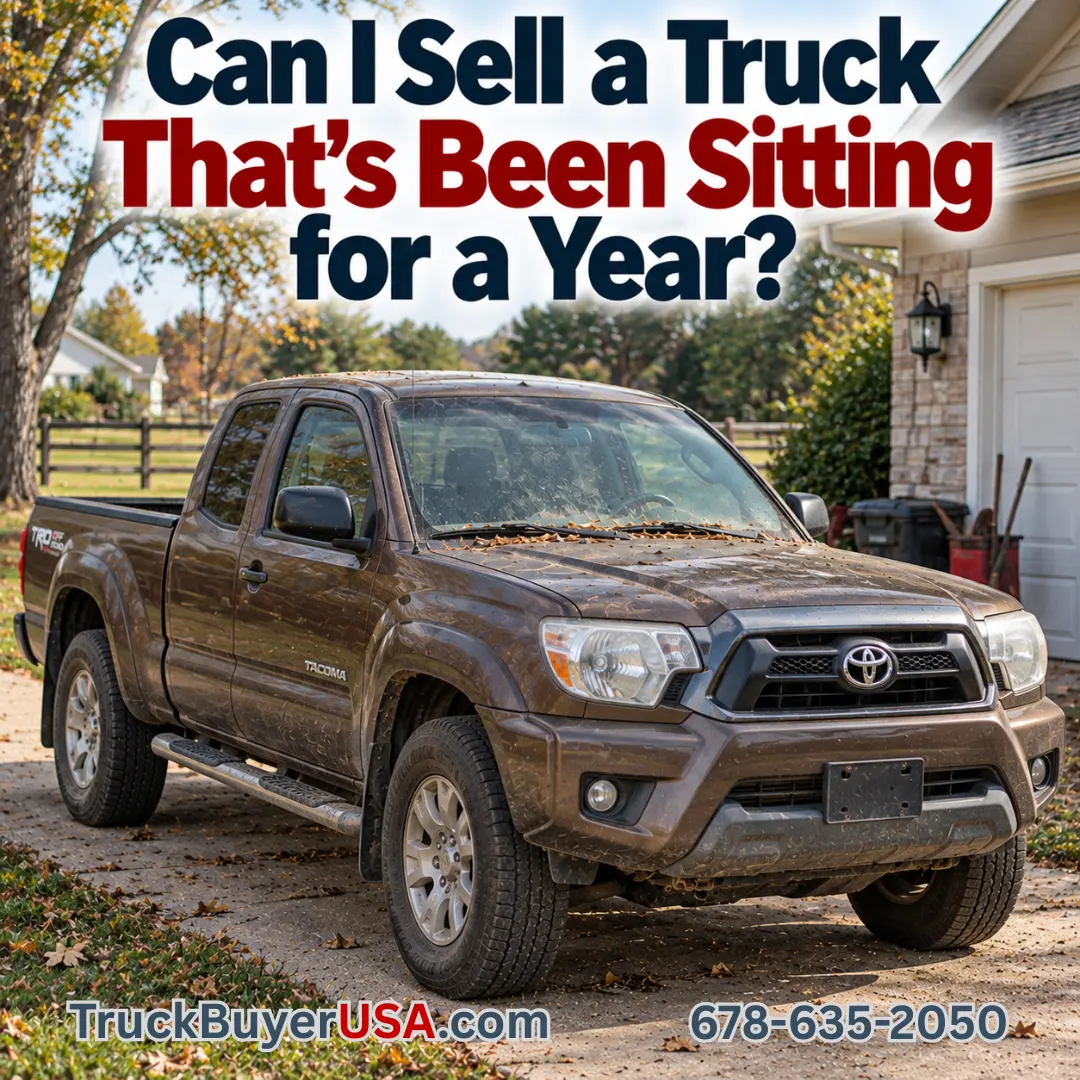
Can I Sell a Truck That’s Been Sitting for a Year?

- Tuesday, September 22, 2026

Yes — Because Waiting Another Year Probably Isn’t Going to Make It Younger, Healthier or More Valuable...NOT!

TruckBuyerUSA - Can I Sell a Truck That’s Been Sitting for a Year?


There it sits...maybe it’s beside the garage, behind the barn or occupying the same driveway spot it claimed sometime last year. You keep telling yourself you’re going to drive it again, fix it, restore it or “get around to doing something with it.”

Meanwhile, your truck has been doing exactly what vehicles are notoriously bad at doing: Absolutely nothing.

A truck that has been sitting for a year can absolutely be sold. In fact, if you no longer need it, selling it now may make considerably more sense than allowing another year of deterioration to pile onto the first one.

Sitting Is Not the Same Thing as Preserving

There’s a strange assumption that because a truck isn’t accumulating mileage, it isn’t experiencing wear. Unfortunately, vehicles didn’t get that memo.

Batteries discharge. Tires lose pressure and can develop flat spots. Brake components can corrode. Fuel deteriorates. Rubber components age. Fluids can absorb moisture, seals can dry out and rodents occasionally decide your engine compartment looks like excellent real estate.

And if the truck has been sitting outside, add sun, rain, snow, humidity, dirt and temperature swings to the party. A year without adding miles does not necessarily mean a year without deterioration.

WHAT CAN HAPPEN WHILE YOUR TRUCK JUST SITS?

Potential Problem
What a Year of Sitting Can Do
Battery
May be deeply discharged or completely dead
Tires
Can lose pressure, weather-crack or develop flat spots
Brakes
Rotors and other components may develop corrosion
Fuel
Old fuel can create starting or performance problems
Fluids & Seals
Age, moisture and inactivity can contribute to deterioration
Rodents
Wiring, insulation and nesting areas can become targets
Exterior/Undercarriage
Weather exposure can accelerate fading, corrosion and rust
Resale Condition
Another year sitting rarely improves anything

Don't Turn a Sitting Truck Into a Restoration Project Just to Sell It

This is where owners can make a questionable situation expensive. The truck won't start, so you buy a battery. Then it needs tires. Then the brakes need attention. Then there's a leak. Then you decide it needs detailing because it's filthy from sitting outside.

Pretty soon, you've spent serious money preparing a truck you already decided you don't want. Some repairs may make sense. Others may not, so before throwing hundreds or thousands of dollars at a dormant pickup, find out what it could be worth in its present condition. A non-running or long-sitting truck isn't automatically worthless, especially if the drivetrain, configuration, components and overall vehicle still have value.

Be Brutally Honest About Why It's Still Sitting

If you genuinely plan to use the truck again, that's one thing. But if you've been saying “I'll get it running next month” since last fall, the truck may already have answered the question for you. You're not using it. Meanwhile, registration, insurance, depreciation, maintenance and eventual repairs don't become more attractive simply because you ignore the vehicle.

And no, starting it for five minutes every couple of months doesn't magically transform it into an actively maintained truck. At some point, “I'm going to fix it someday” becomes a storage strategy, not a plan.

TruckBuyerUSA Could Give That Sitting Truck Somewhere Else to Sit

Before buying a battery, ordering tires, calling a tow truck to the repair shop or spending your weekend trying to resurrect a pickup you haven't needed for a year, start with TruckBuyerUSA!

Our team buys trucks nationwide in a wide range of conditions. Older trucks, high-mileage pickups, work trucks and vehicles that have spent more time parked than driven can still be worth evaluating.

Tell our representative what you have and be straightforward about its condition. If it doesn't start, say so. If it's been sitting outside for twelve months, say so. If the battery is dead and the tires look like they remember a different presidential administration, definitely say so.

You don't need to turn an unused truck back into your pride and joy just to find out whether you can sell it.

Stop Waiting for “Someday”

That truck has already spent a year sitting. Giving it another six months probably isn't going to improve the battery, tires, brakes, paint, rust or value.

Go to TruckBuyerUSA.com and find out what your sitting truck may be worth today. Before you spend money bringing it back to life, find out whether selling it as it sits makes more financial sense.

Because if you haven't needed your truck for an entire year, maybe the most useful thing it can do now is turn itself into cash.

Can I Sell My Truck After Moving to a City Where I Don't Need It?

- Tuesday, September 22, 2026

Absolutely! Your Truck Didn't Suddenly Become Useless — It May Have Just Become Useless to You.

TruckBuyerUSA - Can I Sell My Truck After Moving to a City Where I Don't Need It

That pickup made perfect sense when you had a long commute, a big driveway, a trailer to pull, weekend projects or enough room to park without performing a six-point maneuver. Then you moved to the city. Now your truck spends most of its time squeezed into parking garages, circling blocks looking for a space or sitting untouched because taking the smaller vehicle is simply easier.

Here's the good news: there's nothing wrong with admitting you don't need the truck anymore. In fact, selling it while it's still valuable may make considerably more financial sense than paying to keep a vehicle that no longer fits your life.

A Great Truck Can Be the Wrong Vehicle in the Right City

Pickup trucks are incredibly useful when you're actually using their capabilities. Towing, hauling, construction, farming, recreation and home projects can easily justify owning one.

But if your new routine consists of commuting a few miles, parking downtown and picking up groceries, that 6,000-pound pickup may be bringing considerably more truck to the party than you need. The truck isn't the problem, the job you bought it to perform may simply be gone.

WHAT CHANGES WHEN YOUR TRUCK MOVES TO THE CITY?

Before the Move
After the Move
Large driveway or rural parking
Tight garages, street parking or paid spaces
Regular towing
Hitch hasn't been used in months
Frequent hauling
Bed is mostly empty
Longer open-road driving
Shorter stop-and-go trips
Truck size was useful
Size can become inconvenient
Capability justified ownership
You're paying for capability you rarely use
Truck fit your lifestyle
Your lifestyle changed

The Truck Is Still Costing You Money While It Sits

This is the part that's easy to overlook. Not driving the truck doesn't mean owning it is free. You may still have a payment. There's insurance, registration, maintenance and eventual tire and battery replacement. Depending on where you live, you might even be paying separately for parking.

Meanwhile, the truck is getting older. Keeping a vehicle because you might need a pickup three times next year deserves some math. Renting or borrowing a truck occasionally could make more sense than paying twelve months of ownership expenses for something you rarely drive. And no, using the bed once to bring home a television doesn't automatically justify another year of ownership.

Don't Wait Until the Truck Becomes the One That's Been Sitting

If you've already stopped driving it regularly, pay attention. A truck that sits for months can eventually bring its own problems: discharged batteries, deteriorating tires, corrosion and other age-related issues. Waiting doesn't automatically improve your selling position.

If the truck is currently running well, maintained and presentable, this may be exactly when you should find out what it's worth, not two years from now after you've ignored it.

Your City Doesn't Need Your Truck. Somebody Else Might.

This is where TruckBuyerUSA becomes particularly useful.

Instead of spending weeks listing your pickup privately and coordinating messages, meetups and test drives around your new city schedule, start by finding out what your truck may be worth through TruckBuyerUSA.

Our team buys trucks nationwide, so selling isn't limited to whether someone around the corner happens to need your particular pickup. Your truck's year, mileage, configuration, trim, drivetrain, equipment and condition can all contribute to its value even if those capabilities aren't useful to you anymore.

That diesel engine, four-wheel drive or long bed may no longer serve much purpose in your new city lifestyle, but those same features could be exactly what another truck buyer needs. The capability you're no longer using hasn't disappeared...it may simply be time to put that truck in the hands of someone who will use it.

Stop Paying for a Truck Your Old Life Needed

Moving often changes more than your address. It changes how you commute, where you park and what you genuinely need from a vehicle.

If your pickup has become an expensive piece of curb decoration, don't keep paying for capability you're no longer using just because the truck once made sense.

Go to TruckBuyerUSA.com and find out what your truck may be worth. You don't have to wait until it's old, neglected or becoming a maintenance headache to sell it.

Your truck did its job. Your life changed. Now let us help you turn the truck you don't need into money you can actually use.

KBB Truck Valuation

- Thursday, September 17, 2026

YOUR TRUCK HAS A BOOK VALUE. THE REAL WORLD HAS OTHER IDEAS.


If you're searching KBB truck valuation, you're probably not doing it because you suddenly developed an academic interest in pickup-truck depreciation. You want a number.

More specifically, you want to know what your truck is worth before you sell it. That's exactly where valuation research can be useful. It gives you a reference point and helps you understand how factors such as year, mileage, configuration and condition may affect a truck's estimated value. But trucks have a nasty habit of refusing to fit neatly into valuation boxes.

A five-year-old pickup might be a pristine suburban commuter that has never hauled anything heavier than groceries. Another example of the exact same model may have spent five years towing equipment, bouncing through construction sites and hauling loads with a bed that looks like it survived a bar fight... Same year. Same badge on the grille, but very different trucks.

A KBB Truck Valuation Has to Start Somewhere

Any valuation tool needs information to work with. For a pickup, however, seemingly small differences can substantially change what you're dealing with.

Is it 4x4 or 4x2? Gas or diesel? Regular cab or crew cab? Short bed or long bed? Half-ton or heavy- duty? Does it have factory towing equipment? Has it been modified? Has it spent its life hauling a fifth- wheel camper or commuting 12 miles to work?

And then there's condition. A truck can look fantastic in photographs while hiding rust underneath. Another can have a beat-up bed and scratched tailgate while being meticulously maintained mechanically.

That's why a truck deserves more than a glance at a number and an assumption that the job is finished.

Eight Details That Can Change the Truck You're Valuing

Truck Detail
What You Should Be Looking At
Drivetrain
4x4 and 4x2 trucks can attract different buyers
Engine
Gas and diesel trucks have different ownership and use profiles
Cab
Regular, extended and crew cabs serve very different needs
Bed
Bed length can matter to commercial, recreational and everyday buyers
Mileage
The odometer matters, but maintenance and use matter too
Condition
Rust, dents, paint damage and interior wear can affect value
Modifications
Aftermarket equipment doesn't automatically increase resale value
Truck history
Towing, hauling and hard work can leave evidence behind

That $5,000 Upgrade Doesn't Mean Your Truck Is Worth $5,000 More

This one hurts!! Truck owners spend serious money personalizing their pickups. Lift kits, suspension upgrades, oversized tires, aftermarket wheels, running boards, bed covers, toolboxes, lighting and towing equipment can add up fast.

But cost and resale value are two different things. You may love the lift. Another buyer may immediately calculate what it will cost to remove it. You may consider an expensive wheel-and-tire package an upgrade. Someone else may prefer the factory setup.

That's why dumping more money into a truck immediately before selling can backfire. Don't automatically assume another $2,000 in repairs, detailing or accessories will produce another $2,000 at sale time.

High Mileage Doesn't Automatically Send Your Truck to the Graveyard

Then there's the odometer! A truck crossing 100,000 miles doesn't spontaneously become worthless. Neither does one at 150,000 miles. Higher mileage certainly matters, but so do maintenance, mechanical condition, configuration and demand.

This is especially important with trucks because they're built for very different jobs. A seller shouldn't hide mileage, damage, rust or wear. Describe the truck accurately and find out what the truck you actually own may be worth, not the imaginary perfect-condition version of it.

KBB Truck Valuation Got You Here. Now What?

Use a KBB truck valuation as part of your research. Understand the market. Know what you're driving. Know what factors may be helping—or hurting—your truck. But if your ultimate goal is to sell, eventually you need more than another valuation search. You need a buyer, and that's where TruckBuyerUSA changes the conversation.

TruckBuyerUSA buys pickups in a wide range of configurations and conditions. Instead of endlessly comparing valuation numbers, private-party listings and trucks advertised by dealers, you can get your truck value and see what your actual pickup may be worth.

No pretending your work truck has never worked. No convincing yourself those expensive modifications automatically increased its value. No spending thousands fixing cosmetic problems before you even know whether the expense makes financial sense.

Your truck is what it is. Gas or diesel. Stock or modified. Daily driver or workhorse. Low mileage or six figures on the odometer. Clean, scratched, dented or carrying years of honest work.

Let TruckBuyerUSA.com value the truck that's actually sitting in your driveway, and if you're ready to sell it, put it in front of a company that's actually ready to buy trucks.

Book values are useful. But you can't deposit a book value in the bank.

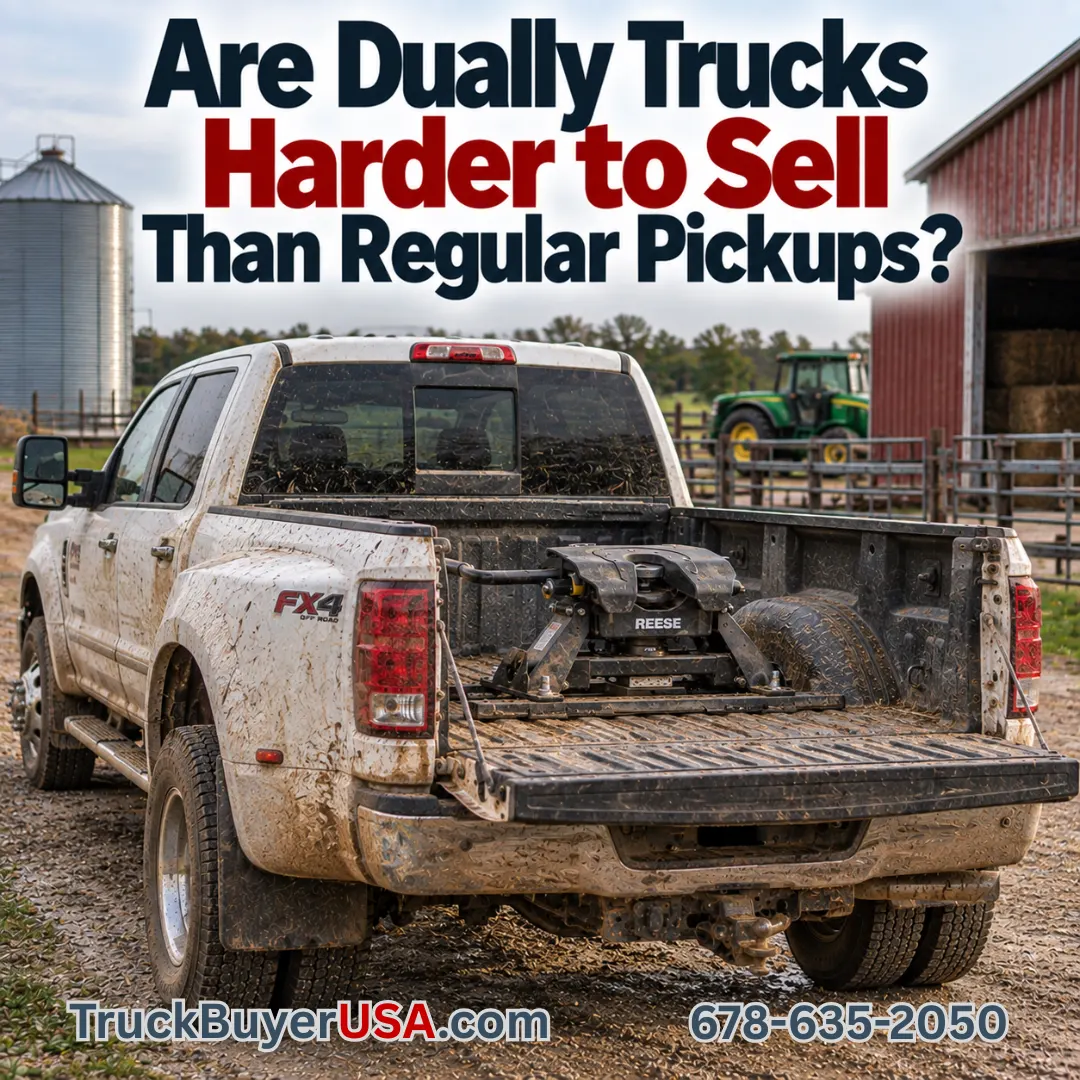
Are Dually Trucks Harder to Sell Than Regular Pickups?

- Wednesday, September 16, 2026

Sometimes — Because That Extra Pair of Tires Comes With Extra Capability, Extra Expense and a Much Smaller Pool of Buyers.

TruckBuyerUSA - Are Dually Trucks Harder to Sell Than Regular Pickups?


A dually can be an absolute beast when there's a fifth-wheel camper, horse trailer or heavy equipment behind it. But take away the trailer and suddenly you're driving an enormous pickup with six tires, a wide rear end and capabilities you may not use anymore.

So, are dually trucks harder to sell than regular pickups? They can be — but not because nobody wants them. The problem is that not everybody needs one. A regular half-ton or three-quarter-ton pickup appeals to an enormous range of drivers. A dual-rear-wheel truck is a specialized machine, and specialized trucks need specialized buyers, and that distinction matters when it's time to sell.

Your Dually Is Valuable — To the Right Buyer

Dual-rear-wheel trucks are designed to provide additional stability and support for demanding hauling and towing applications. Depending on the truck's specific configuration, that can make a dually particularly attractive to RV owners, commercial operators, contractors, farmers, ranchers and people regularly moving heavy trailers.

But here's the brutally honest part: the average pickup shopper probably doesn't need what your dually does.

They're thinking about commuting, parking, fuel costs and replacing six tires instead of four. They're imagining squeezing those rear fenders into parking spaces and maneuvering a truck that may be considerably wider than what they're accustomed to driving.

Meanwhile, the person searching specifically for a properly equipped dually may see exactly what they need.

DUALLY VS. REGULAR PICKUP WHEN IT'S TIME TO SELL

Factor
Dually Truck
Regular Pickup
Buyer Pool
More specialized
Generally broader
Heavy Towing Appeal
Major selling point for the right configuration
Varies considerably by configuration
Everyday Driving
Size can discourage some buyers
Usually easier for everyday use
Tire Replacement
Six tires to maintain and replace
Usually four
Parking/Maneuverability
Wider rear axle and fenders can be inconvenient
Generally easier
Commercial/RV Interest
Can be highly desirable
Selling Strategy
Finding the right buyer matters
Appeals to more types of buyers

Don't Confuse "Harder to Sell" With "Worth Less"

This is where owners can make an expensive mistake. A smaller buyer pool does not automatically mean a dually is worth less than a comparable single-rear-wheel truck. Year, make, model, engine, drivetrain, mileage, trim, condition, options, accident history and market demand all matter.

A well-maintained diesel dually with desirable equipment can be a valuable truck. A trashed dually isn't magically valuable because it has four tires hanging off the rear axle. If yours spent years towing heavy trailers, expect serious buyers to care about how it was maintained. Transmission performance, brakes, suspension, tires, cooling components, drivetrain condition and service history can become important parts of the conversation.

The Private-Sale Headache Can Be Bigger With a Dually

Selling privately means finding the person who doesn't merely like your truck but actually needs its configuration — and is prepared to pay accordingly.

That can mean answering endless questions about towing, payload, hitch equipment, maintenance and modifications. It can mean strangers inspecting the truck, arranging test drives and trying to negotiate your price into the basement because they know your buyer pool is smaller.

And if the truck is older, high-mileage, cosmetically rough or has spent its life working, the process can become even more frustrating.

You don't need 500 people interested in your dually. You need one serious buyer. Put TruckBuyerUSA in That Conversation Before listing your dually and waiting for the right private buyer to stumble across it, see what TruckBuyerUSA may offer.

TruckBuyerUSA specializes in trucks, which matters when you're selling something more complicated than an everyday commuter vehicle. Your dually's engine, drivetrain, cab configuration, bed, trim, equipment, mileage and condition all help define the truck you're actually selling.

That means you don't have to strip away useful equipment, pretend the truck never worked or spend a fortune making a hardworking pickup look showroom-new before finding out what it may be worth.

Go to TruckBuyerUSA and get your truck evaluated before you start chasing private buyers or pouring money into unnecessary repairs. Your dually may be too much truck for the average driver.

That's fine. You're not trying to sell it to the average driver. Six Tires. One Truck. Zero Reason to Let It Sit Around Unused.

If the fifth wheel is gone, the work has slowed down or you're simply finished paying to own more truck than you need, turn that dually into money instead of driveway furniture. Visit TruckBuyerUSA.com, find out what it's worth and put that heavy-duty truck in the hands of a buyer who understands what it is.

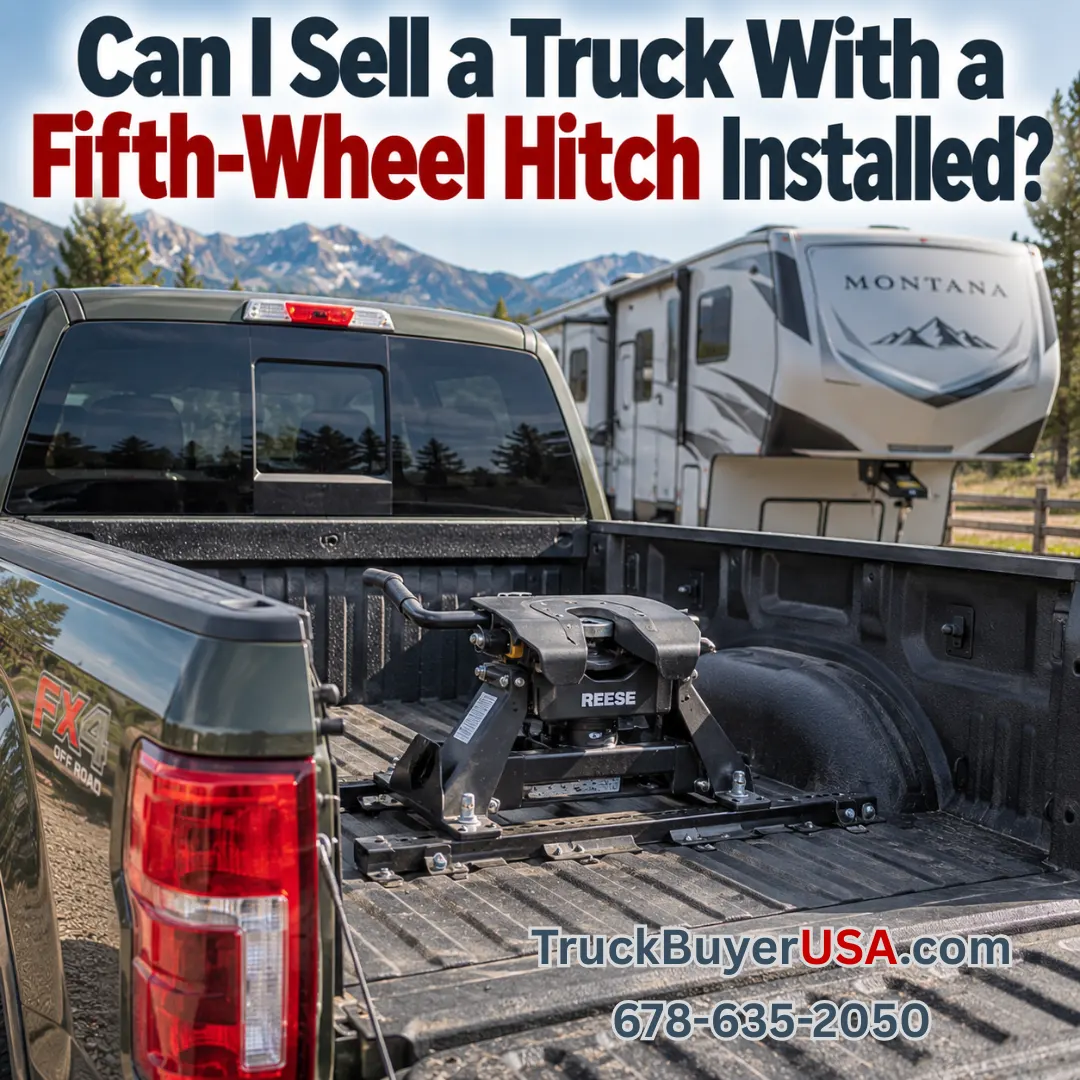
Can I Sell a Truck With a Fifth-Wheel Hitch Installed?

- Tuesday, September 15, 2026

Absolutely — But Before You Start Unbolting Everything, Find Out Whether That Fifth-Wheel Setup Should Stay With the Truck.

TruckBuyerUSA - Can I Sell a Truck With a Fifth-Wheel Hitch Installed?


If you've used your pickup to pull a fifth-wheel camper, horse trailer or heavy equipment trailer, there's a good chance the bed doesn't look like it did when the truck left the factory. You may have rails, mounting points, brackets or an entire fifth-wheel hitch sitting back there.

Now you're ready to sell the truck, and the obvious question is: Do I have to remove all of that first? Usually, no. You can sell a truck with a fifth-wheel hitch installed. In some cases, leaving the towing equipment in place may actually make the truck more appealing to the right buyer. In others, the hitch itself may add little to the truck's resale value.

The important thing is not to start spending money removing equipment until you understand what you're selling.

A Fifth-Wheel Hitch Tells Buyers Something About the Truck

A properly installed fifth-wheel setup can be useful equipment. Someone shopping specifically for a tow vehicle may appreciate finding a truck that's already equipped for the job.

But the hitch also tells a buyer something else: this truck has probably towed. That isn't automatically bad. Heavy-duty pickups are built to work, and towing is exactly why many people buy them. However, buyers evaluating a used tow vehicle may pay closer attention to mileage, transmission performance, cooling systems, suspension, brakes, tires, rear axle components and maintenance history.

A fifth-wheel hitch doesn't automatically hurt your truck's value. The condition of the truck carrying it matters much more.

WHAT SHOULD YOU DO WITH YOUR FIFTH-WHEEL SETUP?

Situation
What Sellers Should Consider
Complete hitch still installed
Truck can generally be sold with it in place
Only bed rails/mounts remain
Don't assume removal is necessary before selling
Factory/OEM prep package
Usually best left intact as part of the truck's configuration
Aftermarket under-bed system
Identify the manufacturer/system when possible
Bed has drilled mounting holes
Removing the hitch won't erase the modifications
Rust/damage around mounting points
Disclose it; condition can matter more than the hitch
You want the hitch for your next truck
Determine whether it's compatible before removing it

Don't Spend $500 Solving a $0 Problem

This is where sellers can waste money. You decide the truck needs to look "stock" before you sell it, so you pay a shop to remove the hitch, rails and brackets. Then you discover there are still holes in the bed, mounting hardware underneath or evidence that towing equipment was previously installed.

You've spent money without necessarily making the truck more valuable. Worse, removing a professionally installed towing system simply to make the bed look cleaner could eliminate equipment that another truck buyer would have wanted.

If you're planning to reuse the hitch in another pickup, that's different. But check compatibility first. Bed dimensions, mounting systems, puck configurations and hitch requirements vary. Don't pay to remove equipment based on the assumption that it'll bolt directly into your next truck.

Be Honest About How the Truck Was Used

If your truck spent years pulling a 14,000-pound fifth wheel across the country, don't describe it as Grandma's grocery getter.

That doesn't mean the truck is ruined. It means its actual condition and maintenance history matter. A well-maintained diesel pickup that regularly towed within its capabilities can be a far better truck than one that never pulled a trailer but was neglected for 150,000 miles. Service records can be particularly useful when selling a truck that's clearly been used for towing.

Also know what equipment you're selling. If possible, identify the hitch manufacturer, weight rating and whether the truck has factory towing preparation or aftermarket components. Never assume the presence of a hitch means the truck is rated to tow a particular trailer; actual towing and payload capacities depend on the truck's specific configuration.

Before You Remove That Hitch, Get Your Truck's Value

This is the part that could save you unnecessary work and money. Don't automatically remove the fifth- wheel hitch. Don't automatically repair every hole in the bed. And don't spend hundreds of dollars trying to erase evidence that your pickup was used as a pickup.

Go to TruckBuyerUSA.com and find out what your truck may be worth in its current condition. TruckBuyerUSA buys trucks nationwide, including pickups that have worked, hauled and towed. Whether you've got a diesel dually with a fifth-wheel setup, a heavy-duty work truck or an older pickup that's finished hauling the family RV, start by getting the truck evaluated before spending money preparing it for sale.

Your fifth-wheel hitch doesn't automatically make your truck harder to sell.

The bigger mistake may be paying to remove perfectly usable equipment before you even know whether you need to.

Ready to Stop Towing? Maybe It's Time to Stop Owning the Tow Truck, Too.

Visit TruckBuyerUSA.com, tell us what you've got and get your truck's value. Hitch, rails, towing history and all, let our team evaluate the truck you actually own before you spend another dollar on it.

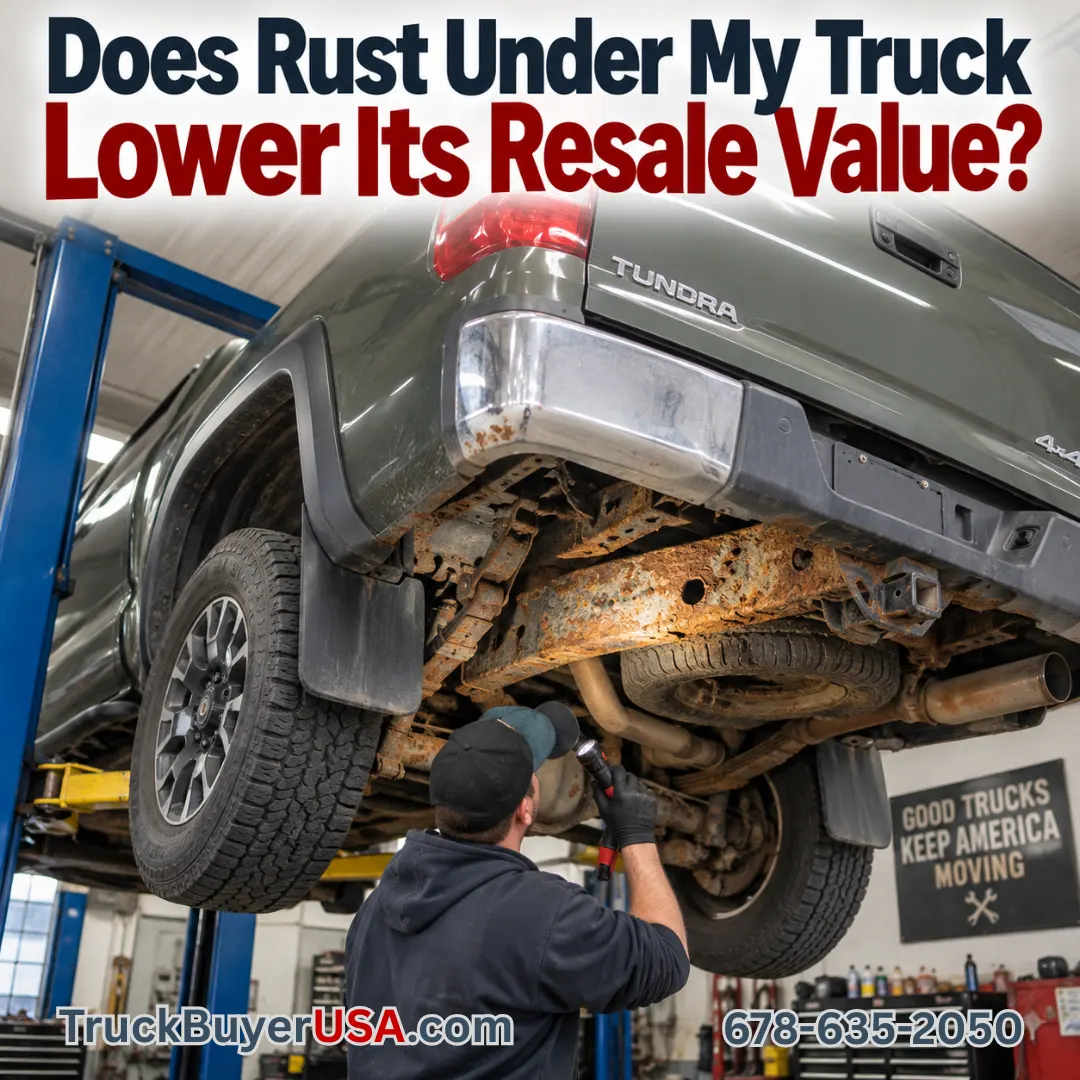
Does Rust Under My Truck Lower Its Resale Value?

- Monday, September 14, 2026

Yes! And the Difference Between Surface Rust and a Rusted-Out Frame Can Mean Thousands of Dollars.

TruckBuyerUSA - Does Rust Under My Truck Lower Its Resale Value?


Rust underneath a truck is easy to ignore because most owners don't spend much time crawling around underneath their pickups. The paint may still look good, the engine may run beautifully and the truck may drive every day without a problem. Unfortunately, none of that means the underside is in equally good condition.

Yes, rust can absolutely lower your truck's resale value, and severe rust can lower it dramatically. The real question isn't simply whether your truck has rust. It's where the rust is, how advanced it has become and whether it has moved beyond cosmetic corrosion into structural deterioration.

A Little Rust Isn't the Same as a Rotten Truck

Some surface corrosion is fairly common on older trucks, particularly those that have spent years in areas where winter roads are treated with salt or deicing chemicals. Trucks also encounter mud, standing water and moisture that can remain trapped around frame rails, suspension components and body seams.

Light surface rust doesn't automatically destroy a truck's value. The situation becomes considerably more serious when metal begins scaling, flaking, swelling or deteriorating around structural areas. Once corrosion starts affecting the frame, crossmembers, suspension mounting points or other critical components, buyers aren't looking at an ugly cosmetic problem anymore. They're looking at the possibility of expensive repairs and potentially compromised structural integrity.

WHAT'S ACTUALLY RUSTING UNDER YOUR TRUCK?

What You See
What It Could Mean for a Sale
Light surface rust
Common on older trucks and may have limited effect on valure
Scaling or flaking corrosion
More advanced deterioration that deserves closer inspection
Rusted rocker panels/body mounts
May indicate corrosion extends beyond visible body panels
Corroded brake or fuel lines
Can create additional repair and safety concerns
Heavy frame corrosion
Can significantly reduce desirability and resale value
Frame perforation or holes
Serious structural damage that can dramatically affect value

When It's the Frame, Stop Calling It "Just Rust"

This is where truck owners need to be brutally realistic. Rust on a bumper, exhaust component or replaceable body panel isn't remotely the same issue as extensive corrosion in the frame.

A truck's frame is its structural foundation. When substantial corrosion develops around load-bearing areas, suspension mounting points or crossmembers, the problem can become far more expensive than simply cleaning up some ugly metal. A truck that looks excellent from the outside can still have serious deterioration underneath.

Trying to disguise advanced corrosion isn't a solution either. Heavy undercoating or fresh black paint applied over existing rust doesn't restore missing metal, and an experienced buyer may become even more cautious if it appears someone is attempting to hide what is underneath.

Don't Spend Thousands Fixing Rust Before Knowing What the Truck Is Worth

Discovering rust often sends owners straight into repair mode. Before long, they're pricing frame work, rocker panels, brake lines, welding, replacement components and undercoating. On an older or high- mileage truck, those repairs can quickly become difficult to justify.

Before authorizing thousands of dollars in work, find out what the truck is worth in its current condition. A rusty pickup isn't necessarily worthless. Its engine, transmission, drivetrain, year, mileage, trim, configuration and usable components can still contribute significant value.

That is especially important with older work trucks, farm trucks and pickups that have accumulated years of hard use. There comes a point when preserving a truck makes financial sense, and another point when you're simply pouring good money into disappearing metal.

Let TruckBuyerUSA Evaluate the Truck You Actually Have

If you've looked underneath your truck and discovered more rust than you expected, you don't necessarily need to restore it before you can sell it. You need to understand what it's worth right now. Start at TruckBuyerUSA.com and get an offer for the truck you actually own, rather than spending money trying to turn it into something it isn't. TruckBuyerUSA buys trucks nationwide in a wide range of conditions, which can give owners of rusty, aging or high-mileage pickups an alternative to expensive repairs or the headaches of finding a private buyer.

Be straightforward about the corrosion and the truck's overall condition. The rust may reduce its value, but that doesn't mean the truck has no value.

Before you pay to repair it, find out what TruckBuyerUSA may pay you to sell it as-is.

Does My Truck's Trim Level Matter When I Sell It?

- Friday, September 11, 2026

And Guessing Your Truck’s Trim Level Could Cost You Money!

TruckBuyerUSA - Does My Truck's Trim Level Matter When I Sell It?


Two trucks can be the same year, same make, same model and even have nearly identical mileage — yet they can be worth very different amounts. One of the reasons is trim level.

That little badge on the tailgate may represent thousands of dollars in equipment that separates a basic work truck from a luxury pickup. But here's where sellers sometimes get it wrong: a higher trim doesn't automatically guarantee a huge payday, and a lower trim doesn't automatically mean your truck isn't valuable. When you're ready to sell, the entire truck matters.

Trim Is More Than a Fancy Name on the Tailgate

Manufacturers use trim levels to package different combinations of engines, interiors, technology, towing equipment, suspension components and appearance features.

A basic Ford F-150 XL, for example, was designed for a very different buyer than an F-150 Platinum. The same applies to Chevrolet WT versus High Country, GMC Pro versus Denali, or Ram Tradesman versus Limited.

Those differences mattered when the truck was new, and many of them can still matter when it's time to sell.

Leather seating, upgraded infotainment, premium audio, larger wheels, advanced driver-assistance technology, four-wheel drive and factory towing equipment can all make one version of a truck more desirable than another.

But there's another side to the equation.

HOW TRIM CAN AFFECT YOUR TRUCK'S VALUE

Truck Factor
Why It Matters When Selling
Higher Trim Level
May include expensive equipment and luxury features buyers want
4WD / Off-Road Package
Can increase desirability depending on truck and market
Factory Tow Package
Useful equipment for buyers who actually use their trucks
Premium Interior
Leather, heated/cooled seats and technology may add appeal
Base / Work Trim
Can still be desirable for commercial, fleet and work use
Condition & Mileage
Can outweigh the advantage of having a higher trim

Don't Assume the Most Expensive Trim Is Always Worth More

This is where sellers need to be realistic. A loaded truck with 180,000 hard miles, accident damage, warning lights and a destroyed interior isn't automatically more valuable than a well-maintained lower- trim truck simply because it says Denali, Platinum or Limited on the back.

Condition matters. Mileage matters. Mechanical health matters. Accident history matters. Configuration matters. And demand matters. In fact, basic work-oriented trims have their own market. Contractors, businesses, farmers and buyers looking for an actual working pickup may care considerably more about capability, condition and reliability than leather seats or premium speakers.

Don't sell the badge. Sell the truck.

Know Exactly What You Own Before You Ask What It's Worth

If you're requesting an offer, don't guess at your trim. Look at your original paperwork, VIN information or manufacturer specifications. Trucks can have optional packages that aren't obvious from the exterior, and those options may matter when the vehicle is evaluated.

That is especially important if your truck has factory towing equipment, an upgraded engine, four-wheel drive, an off-road package or other desirable equipment. And don't assume you need to spend hundreds or thousands of dollars getting your truck ready to sell before finding out what it's worth.

Find Out What Your Truck Is Worth From TruckBuyerUSA

Whether you've got a loaded luxury pickup, a basic work truck, an older farm truck or something in between, TruckBuyerUSA wants to evaluate the truck you actually own — not just the badge attached to it.

Before spending money on repairs, detailing or upgrades you may never recover, go to TruckBuyerUSA.com and find out what your truck could be worth.

Your trim level matters, but so does everything attached to it.

Get the value first. Then decide whether keeping that truck still makes sense.


How It Works

We Buy Any Truck in any condition, anywhere in the Continental USA.

1 Get an Instant Cash Offer
Enter the Year, Make, Model, Trim Level & Miles (No VIN Required) and your cash offer appears onscreen (94% of the time)
2 Accept your offer
TruckBuyerUSA offers are Cash Market Value. Funds are guaranteed and paid at the time of pickup or drop-off
3Talk to an Agent
Your TruckBuyerUSA representative schedules a no obligation mobile inspection - TruckBuyerUSA comes to you. Digital purchase agreement takes less than 60 seconds to complete.
4 Get Paid
When TruckBuyerUSA picks up your truck, you are paid on the spot in full with guaranteed funds – entire process is hassle free. Inspection, title work & pick up are all FREE.

Onscreen Quote in seconds No Personal Info Required